One Writer's Journey Through Parenting, Teaching, Writing, Faith, and Social Justice. A.E. Housman once claimed that "poetry is not the thing said, but a way of saying it." These are my attempts at a way of saying it. Too often, we erect walls where a few stoplights would do the trick. Consider these posts stoplights along the way.
Showing posts with label Creativity. Show all posts
Thursday, May 19, 2016
Poem for the Maybe-Inclined
Open up the world.
See it for its breadth, depth, beauty, pain.
Life is bigger than we think.
Smaller than we scoff.
Go out and touch it.
See it.
Swim in the oxygen that
Sits still unless we take
Staccato breaths
And big steps
Off cliffs, out of boxes,
Where the air is thin and
Meaning is thick.
Reach.
Teach.
Learn.
Burn.
Think not of thriving
Or of dying,
But of all that is
Waiting to come alive.
Labels:
Benjamin,
Creativity,
hope,
Love,
parenting,
poetry,
risk,
taking the leap,
Tyler,
Writing
Friday, May 13, 2016
Why We Remember
Lately, our two-year old, Benjamin, has taken to becoming a mini-Chris Farley in every aspect of his conversational life. Just like that fabulous persona on SNL where Farley portrayed an interviewer who began every question with "Remember when...?" Ben has been imbued with such a trait lately.

Ben's questions come at the most random times. When we're sitting eating dinner together, Ben will suddenly look up and out with blazing eyes and remark with rapture on his face: "REMEMBER DINOSAUR AT BARNES AND NOBLE!?"
This would be referring to a dinosaur book at Barnes and Noble where, when you push a button, the dinosaur selected subsequently responds with a resounding ROAR!
Tyler, Jennifer, and I all answer Ben, "Yes, we remember that dinosaur Ben!"
To which Ben replies, "Dino say ROAR at Barnes and Noble!"
At other times, we will, all four of us, be snuggled on the couch together ready to rock and roll with some reading before bed, and Ben will spontaneously pipe up, "Remember boy fell down!?"
It referred to an incident three weeks when, at the beach, a boy had fallen while he was running and began to cry with every bit of lung capacity he possessed.
"Yes, Ben. we remember that."
"That boy OKAY, that boy OKAY, that boy gon' to be OKAY."
To which we respond, of course, "Yes, Ben, that boy will be okay. he is all-okay!"
Jen and I have talked a lot lately about how fast everything seems to move. Rushing out in the mornings to get to school on time, rushing to get papers written and deadlines met, rushing to make dinner to get int the bath on time to read books to get to bed before OH MY GOSH HOW IS IT ALREADY 9;30!?
And with the rampant pace--and the rampant news cycle to keep up with, and all the beautiful and glorious work that we so long to do to make the world just the tiniest bit better--remembering seems to take a back seat to the NOW, to the DO, to the MOVE MOVE MOVE.
But maybe Chris Farley, and our little guy Ben, are on to something.
Maybe there's more to Remembering than meets the eye. Maybe slowing down and focusing less on the what-still-needs-to-happen and more on the what-work-has-already-been-done, we actually grow. Maybe it's in those spaces where we experience life close to the bone and learn from it, celebrate it, and remember it, that help us feel content and even peaceful.
As Sarah Lewis claims in her inspiring Ted Talk, after all, sometimes mastery isn't about the absolute best and the absolute perfection; rather, it's about coming close and celebrating that fact--even enjoying it.
Remembering reminds us that while we have much to do, we have also already done much. Remembering also reminds us that we do not need to make the same mistakes twice--we can learn from the errors we've already encountered and, by slowing our pace and taking the hand of a friend beside us, move forward with a little more wisdom.
I hope to practice the art of remembering a little more, and striving a little less.
Thursday, March 17, 2016
Of Soup and Synthesis
A few nights ago, Tyler announced that he wanted to make dinner for Jen, Ben, and I.
"What are you going to make?" We wondered aloud.
"You'll see!" came the excited retort.
And so, we saw.
Tyler asked Jen to purchase a number of items from the store--red peppers, onions, garlic, avocado, grape tomatoes, tomato sauce...and a few hours later Tyler was at the stove adding ingredients into one pan and getting ready to chop up others and fry them in another pan. The entire time, as he progressed in his yet-unannounced recipe preparation--he voiced aloud exactly what he was doing as he was working off the set of his own veritable cooking show.
Hearing our seven old utter sentences like, "So what I'm doing here is I am cutting these peppers into very tiny pieces to get them all to be just the right size for the mix" filled us with a synthesis of wonder and delight.
We relished it. (Even if we were just a bit mystified and fearful of how the eventual result would taste.)
Fast forwarding an hour later, we all sat down do a kind of soup. The onions had been fried and we browned just towards the heavy side of soft, the peppers were (as predicted) just the right size, and the other ingredients seemed to elbow out their space in the mixture to announce themselves subtly yet powerfully enough to get noticed--"Hey man! I may be small and have strange ties to varies but I AM HERE TOO" said the garlic.
In the days that have followed, I've thought a lot about soup.
Soup.
It's a synthesis really, and I have thought a lot about synthesis lately, too, since my 7th graders just finished writing their synthesis essays and since my school backpack is burdened with the 100 essays labeled TO BE GRADED.
The theme my thoughts have taken with all of this soup and synthesis has coalesced into one curiosity today: I wonder how many students in our schools feel like they can make their own soup?
In other words, I am wondering how often we ask our students--and our children--to work with the ingredients they know and come up with new possibilities. Instead of handing them recipes to be followed meticulously, how often do we let their minds wander around the educational grocery store and say, come up with something new!
RUBRIC is a buzzword we hear everywhere these days, and if I ever assign some kind of writing and don't provide a rubric (which is becoming more and more frequent!) I certainly hear the fear that arches back: "But how will we KNOW what to produce?!"
And the answer that rises up--the YAWP if we can invoke a little Whitman here--is simply, "You won't!"
And maybe that's okay. Maybe that's even a good thing.
In one of his poems, the great rule-breaker e.e. cummings wrote, "I would rather learn from one bird how to sing / than teach ten thousand stars how not to dance." Maybe part of what he meant here relates to soup and synthesis. Maybe part of what he meant was about learning a new song rather than teaching what NOT to do because it's not on the rubric.
I have a lot to learn. And watching my seven year old son make soup, I felt a kind of challenge from the young to the old: watch this, Dad. It doesn't have to be all planned out. I don't even have to know what I am doing! And it will be okay!
It may not always taste great. But then again, isn't that, too, what real learning is all about?
"What are you going to make?" We wondered aloud.
"You'll see!" came the excited retort.
And so, we saw.
Tyler asked Jen to purchase a number of items from the store--red peppers, onions, garlic, avocado, grape tomatoes, tomato sauce...and a few hours later Tyler was at the stove adding ingredients into one pan and getting ready to chop up others and fry them in another pan. The entire time, as he progressed in his yet-unannounced recipe preparation--he voiced aloud exactly what he was doing as he was working off the set of his own veritable cooking show.
Hearing our seven old utter sentences like, "So what I'm doing here is I am cutting these peppers into very tiny pieces to get them all to be just the right size for the mix" filled us with a synthesis of wonder and delight.
We relished it. (Even if we were just a bit mystified and fearful of how the eventual result would taste.)
Fast forwarding an hour later, we all sat down do a kind of soup. The onions had been fried and we browned just towards the heavy side of soft, the peppers were (as predicted) just the right size, and the other ingredients seemed to elbow out their space in the mixture to announce themselves subtly yet powerfully enough to get noticed--"Hey man! I may be small and have strange ties to varies but I AM HERE TOO" said the garlic.
In the days that have followed, I've thought a lot about soup.
Soup.
It's a synthesis really, and I have thought a lot about synthesis lately, too, since my 7th graders just finished writing their synthesis essays and since my school backpack is burdened with the 100 essays labeled TO BE GRADED.
The theme my thoughts have taken with all of this soup and synthesis has coalesced into one curiosity today: I wonder how many students in our schools feel like they can make their own soup?
In other words, I am wondering how often we ask our students--and our children--to work with the ingredients they know and come up with new possibilities. Instead of handing them recipes to be followed meticulously, how often do we let their minds wander around the educational grocery store and say, come up with something new!
RUBRIC is a buzzword we hear everywhere these days, and if I ever assign some kind of writing and don't provide a rubric (which is becoming more and more frequent!) I certainly hear the fear that arches back: "But how will we KNOW what to produce?!"
And the answer that rises up--the YAWP if we can invoke a little Whitman here--is simply, "You won't!"
And maybe that's okay. Maybe that's even a good thing.
In one of his poems, the great rule-breaker e.e. cummings wrote, "I would rather learn from one bird how to sing / than teach ten thousand stars how not to dance." Maybe part of what he meant here relates to soup and synthesis. Maybe part of what he meant was about learning a new song rather than teaching what NOT to do because it's not on the rubric.
I have a lot to learn. And watching my seven year old son make soup, I felt a kind of challenge from the young to the old: watch this, Dad. It doesn't have to be all planned out. I don't even have to know what I am doing! And it will be okay!
It may not always taste great. But then again, isn't that, too, what real learning is all about?
Thursday, January 14, 2016
Blasting Off Into Imagination
Five years ago, when my oldest son was 2, a laundry basket sat nearby us on the floor just before bedtime. Already, Jen had created the giddy habit of pushing Tyler around in the laundry basket all over our small carpeted apartment as he shouted wildly.
And so, when I should have been getting Tyler into the bath and the bedtime routine, he instead climbed into the laundry basket and looked up at me with wide, wondering eyes.
"Bedtime?" I asked.
"Not yet!" Tyler shouted, and then proceeded to bounce up and down in the laundry basket.
And so, instead of talking with Tyler about the importance of following routines and getting good sleep, I grabbed hold of the handle and proceeded to push. (Does this explain possible sleep problems now...hmmm...we'll deal with that in a subsequent post!)
Tyler's head tilted back and we raced around the apartment, turning the laundry basket into a jet, a boat, a bulldozer, a rocket ship, a fire truck, and more. With each new imaginative sequence, we changed our accompanying sounds and motions and let loose.
Twenty minutes later--me breathless as an out-of-shape Daddy and Tyler breathless for an in-shape screaming little guy--we both flopped onto the floor near the bathroom.
"Bedtime?" I asked.
"Not...yet..."
Later that night, when Tyler was finally asleep in his crib, I sat down at the desk and began journaling. But instead of writing about the day at school teaching, or a cool conversation Jen and I had shared, or about the book I was reading, or about the weather (Get the weather in! Hemingway always exhorted), I wrote a poem.
It was a very simple, short poem that essentially walked through the stages of our little imaginative adventure.
So it is especially fun and with great gobs of gratitude (what do gobs of gratitude look like? I imagine them to be like handfuls of strawberry jam ready to be propelled onto giant-sized pieces of toast) that I wait with excitement to see the picture book Bedtime Blastoff! be released on January 26th.
Even though the poem was written in a single night after our play, it proceeded to go through more than a dozen revisions and still take 3 years to get it towards its journey of becoming an actual book. But what I most appreciate is the small ways wise people helped to fiddle with each phrase, wonder about each scene, imagine the imaged with fresh perspectives--people like my wife, Jen, who is the catalyst for the idea in the first place! And people like my agent Ammi-Joan Paquette whose excitement and work with the manuscript helped it reach its eventual publisher. And people like editor Orli Zuravicky whose energy and zeal and interest propelled it towards its finish.And to awesome artist Mike Yamada who brought the scenes to vividly to life!
But what I am most grateful for is Tyler. And children. They come ready to any situation with the innate and infinite capacity to imagine. A piece of wood can become a talking robot; a laundry basket can become a host of vehicles; a tree can become a space station; anything can be transformed into something beautiful, jovial, miraculous, and fresh.
And I still see glimmers of this kind of willingness to imagine in my 7th graders, too. When they write creatively, when they let go of the worry about a grade and delve into the hope for a new world, their eyes sparkle and they seem somehow free.
Jen and I talk often about how to balance all the little necessities of life--the worries about paying bills, the to-do lists of parenting and teaching and finishing degrees and laundry (laundry, always laundry, aaaahhhhhh!) with the need for imagination. And it isn't always apparent how to do so, but when we go on a family hike up a mountain or climb a massive rock along the trail, we all start to feel like the mountain might be something more than a mountain, the rock might be something more than a rock.
Our lives are imbued with a sense of symbolism--that what we do in our most basic, physical ways can actually represent so much more. And it's this ability to leap from logic to liberty--to live, for a while, with the symbol rather than the definition--that energizes us for the to-do lists of normal life.
And this possibility is what excites me most about parenting and teaching.
And so, when I should have been getting Tyler into the bath and the bedtime routine, he instead climbed into the laundry basket and looked up at me with wide, wondering eyes.
"Bedtime?" I asked.
"Not yet!" Tyler shouted, and then proceeded to bounce up and down in the laundry basket.
And so, instead of talking with Tyler about the importance of following routines and getting good sleep, I grabbed hold of the handle and proceeded to push. (Does this explain possible sleep problems now...hmmm...we'll deal with that in a subsequent post!)
Tyler's head tilted back and we raced around the apartment, turning the laundry basket into a jet, a boat, a bulldozer, a rocket ship, a fire truck, and more. With each new imaginative sequence, we changed our accompanying sounds and motions and let loose.
Twenty minutes later--me breathless as an out-of-shape Daddy and Tyler breathless for an in-shape screaming little guy--we both flopped onto the floor near the bathroom.
"Bedtime?" I asked.
"Not...yet..."
Later that night, when Tyler was finally asleep in his crib, I sat down at the desk and began journaling. But instead of writing about the day at school teaching, or a cool conversation Jen and I had shared, or about the book I was reading, or about the weather (Get the weather in! Hemingway always exhorted), I wrote a poem.
It was a very simple, short poem that essentially walked through the stages of our little imaginative adventure.
So it is especially fun and with great gobs of gratitude (what do gobs of gratitude look like? I imagine them to be like handfuls of strawberry jam ready to be propelled onto giant-sized pieces of toast) that I wait with excitement to see the picture book Bedtime Blastoff! be released on January 26th.
Even though the poem was written in a single night after our play, it proceeded to go through more than a dozen revisions and still take 3 years to get it towards its journey of becoming an actual book. But what I most appreciate is the small ways wise people helped to fiddle with each phrase, wonder about each scene, imagine the imaged with fresh perspectives--people like my wife, Jen, who is the catalyst for the idea in the first place! And people like my agent Ammi-Joan Paquette whose excitement and work with the manuscript helped it reach its eventual publisher. And people like editor Orli Zuravicky whose energy and zeal and interest propelled it towards its finish.And to awesome artist Mike Yamada who brought the scenes to vividly to life!
But what I am most grateful for is Tyler. And children. They come ready to any situation with the innate and infinite capacity to imagine. A piece of wood can become a talking robot; a laundry basket can become a host of vehicles; a tree can become a space station; anything can be transformed into something beautiful, jovial, miraculous, and fresh.
And I still see glimmers of this kind of willingness to imagine in my 7th graders, too. When they write creatively, when they let go of the worry about a grade and delve into the hope for a new world, their eyes sparkle and they seem somehow free.
Jen and I talk often about how to balance all the little necessities of life--the worries about paying bills, the to-do lists of parenting and teaching and finishing degrees and laundry (laundry, always laundry, aaaahhhhhh!) with the need for imagination. And it isn't always apparent how to do so, but when we go on a family hike up a mountain or climb a massive rock along the trail, we all start to feel like the mountain might be something more than a mountain, the rock might be something more than a rock.
Our lives are imbued with a sense of symbolism--that what we do in our most basic, physical ways can actually represent so much more. And it's this ability to leap from logic to liberty--to live, for a while, with the symbol rather than the definition--that energizes us for the to-do lists of normal life.
And this possibility is what excites me most about parenting and teaching.
Wednesday, January 13, 2016
Imperially Marching to Elmo's Song
With a 7-year old and a 2-year old at home, we go back and forth between the graces of Elmo and the terror of Darth Vader. Watching my two sons be riveted by each, though, the thing that surprises me most is how they're finding joy in the other's favorite.
Last week, before bath time, Tyler and Ben were both in the living room and we were all dancing our hearts out. Initially, we marched and pivoted and jumped and turned and 360-ed in the air as we listened to the Imperial March of Darth Vader's destruction.
Then, we segued into a giddily gleeful romp to Elmo's Song, roaring the words aloud as we cascaded across the carpet.
Each song brings with it a certain amount of engaged interest, and as we danced our way upstairs for bath time, the two songs seemed to synthesize so that we sang a gobbled, garbled mash-up of Elmo and Darth Vader each marching and playing the piano and somewhere amidst the whole big mess laughter erupted.
Though I would never remind him of this outright, my 7-year old son will still sit and be enraptured by Elmo's song. And my 2-year old son can already say "DARTH VADER SCARY!" with big eyes ready to pop out of his head and bo-ing to the wall on the other side of the room.
Their delight in the music of the other reminds me that fun isn't always about what seems 'cool,' or even about what makes sense (as our mash-up taught me). Delight is about finding surprising ways to interact with all that we experience in our lives. Delight is about dancing goofy moves to scary music, and accomplishing some serous tasks--bath!--to the accompaniment of some goofy music.
As a teacher and as an adult, I think I have a lot to learn from imperially marching to Elmo's song. There is joy and delight to be found in rather serious places, and there is a great sense of purpose to goofiness. And maybe our efforts to try to consistently separate the two should be re-examined.
Last week, before bath time, Tyler and Ben were both in the living room and we were all dancing our hearts out. Initially, we marched and pivoted and jumped and turned and 360-ed in the air as we listened to the Imperial March of Darth Vader's destruction.
Then, we segued into a giddily gleeful romp to Elmo's Song, roaring the words aloud as we cascaded across the carpet.
Each song brings with it a certain amount of engaged interest, and as we danced our way upstairs for bath time, the two songs seemed to synthesize so that we sang a gobbled, garbled mash-up of Elmo and Darth Vader each marching and playing the piano and somewhere amidst the whole big mess laughter erupted.
Though I would never remind him of this outright, my 7-year old son will still sit and be enraptured by Elmo's song. And my 2-year old son can already say "DARTH VADER SCARY!" with big eyes ready to pop out of his head and bo-ing to the wall on the other side of the room.
Their delight in the music of the other reminds me that fun isn't always about what seems 'cool,' or even about what makes sense (as our mash-up taught me). Delight is about finding surprising ways to interact with all that we experience in our lives. Delight is about dancing goofy moves to scary music, and accomplishing some serous tasks--bath!--to the accompaniment of some goofy music.
As a teacher and as an adult, I think I have a lot to learn from imperially marching to Elmo's song. There is joy and delight to be found in rather serious places, and there is a great sense of purpose to goofiness. And maybe our efforts to try to consistently separate the two should be re-examined.
Monday, May 6, 2013
George Saunders on Enduring Hardships Along the Way
Lately, I've been re-reading the interviews within Keep Calm and Query On--and I've been overwhelmed by the gratitude I feel towards these authors for sharing so much of their writing journeys. Inspired by the pluck and determination of the 14 authors whose interviews appear in the book, I wanted to share some snippets of their wisdom here. Up first is a powerful (and funny) answer from fiction writer and essayist George Saunders on writing your heart out, realizing you might have been wrong, but then writing your heart out all over again.
Can you recall any
moments when you felt particularly discouraged as a writer? What helped to
sustain your belief in your work and in yourself on these occasions?
There were certainly times where I should have felt
discouraged but even at those low points I was arrogant or hopeful or deluded
enough to put the bad news behind me pretty quickly, I think. I once wrote a 700-page book about a Mexican
wedding of a friend of mine, which was called La Boda de Eduardo. Roughly
translated: Ed’s Wedding. Enough said.
That one took about a year of work and lots of late nights at a time
when we had a new baby at home and I was working full-time. So when it turned out to suck, that was a
hard blow. But in my heart I think I
knew it sucked, so it was also kind of a relief—to find out I was right re. the
sucking and that my taste was still active, so to speak. And also a relief to put that book (or, libro, as I might have called it back
then) behind me and move on to something more worthwhile and...alive. There is something so wonderful about writing
in a way that feels new and authentic, that feels in line with your true taste
– trying to get that to that place is like seeking the Grail. Whatever hardships have to be endured along
the way, are fine – part of the larger quest, if you will. Although – I didn’t
feel that way the day after La Boda de
Eduardo went in El Garbago.
Saturday, January 19, 2013
Novel Ideas (Titles Included!)
Today's post is especially for writers--but it may also be of use to those struggling with how to find exactly the right words for certain amorphous emotions. Sometimes, we all get struck. The idea well runs dry, or the idea well runs dry, or we just feel like the idea well runs dry. For times like that, this post is essential. Already, this post has been hailed by major newspapers and magazines and also by international movie festival circles as "Pure Awesomeness Sliced Into Delightfully Thin Slices and Then Packaged as Deli Meat But Given Free of Charge."
Bono has called this post, "Mesmerizing."
The rest of the U2 band called this post, "Deeply Mesmerizing."
Michiko Kakutani has written, "Now that I have explored Luke's post for the thirty-second time, I am convinced that I have simply found the most perfect piece of English prose ever crafted."
Ryan Gosling was overheard shouting, "Yes! It's the one. I found it!"
Without further ado, then, here are NOVEL IDEAS (Titles Included!). Grab any one of these ideas, and go write that book you always knew you had inside of you.
1.
Title: Moon's Holiday
Premise: The Moon (as protagonist) becomes angry at the Sun's constant need to be "the source of all energy" and decides once and for all that he [note: possible angle of added tension if the moon is female while the sun is a patriarchal male figure] will take a holiday. After this occurs (which happens to be forty thousand years in the future), humankind must endure the destructive consequences of this holiday: no more frozen yogurt, constant replaying of old Burt Reynolds movies on every television channel, and the mysterious disappearance of all suspenders everywhere.
2.
Title: You Got Me, Babe
Premise: Conny and Sher are two people madly in love, but then they each begin growing a strange antennae from their heads. At first, each thinks the other is the only one with this strange metallic device poking out from their hair. But then, in Chapter 40, they finally look in a mirror and realize IT'S GROWING ON BOTH OF THEM. (Ends with this huge reveal and then leads into Book Two of the trilogy, where more stuff happens.)
3.
Title: Whether 'Tis Nobler in the Mind to Suffer the Slings and Arrows
Premise: This novel can pretty much be about anything. Because its title is taken from Shakespeare. And titles taken from Shakespeare are awesome. They rock.
4.
Title: Beach, Magnifying Glass, Condensation
Premise: An avid beach-walker finds a strange coin one morning on her beach walk. She leaves it on the nightstand later that night when she goes to bed. In the middle of the night the coin wakes her up by doing historical (and mind-bendingly accurate) impersonations of famous figures--Winston Churchill, George Bush (both) and other famous people that you can insert at will. As the novel progresses (and tension rise), the woman (who is named Samantha) must decide whether she will maintain her loyalty to the Talking Coin and resist what society tells her (That she is psychotic) or whether she will undergo therapy and intensive hospitalization.
Also, at the end of every chapter of the book, Samantha makes various smoothies. Each time, she uses different varieties of fruits, milk, yogurt, and sometimes even raisins and / or dried cranberries.
5.
Title: Yes, You Know That I am Talking To You
Premise: This book is told int eh second person. The novel centers around an elite group of army intelligence personnel (retired) who are convinced of a conspiracy plot to overthrow the current government. After lots of intrigue, wrongful-accusations, and unnecessary violence, the crew of underdogs finally prove the conspiracy, but just as they do so, the President orders for them to be summarily executed. Can they prove their innocence and resist the Covert Executive Order and save America before it's too late?
*Note: throughout the novel, many people will say (during dialogue): "Yes, you know that I am talking to you," which readers will begin to think of as a refrain. Then, this will also (somehow) be the last line of the book. And there will be a secret page that is folded into the hardcover copy of the book, which, when readers find it and pull it out, will say, Yes, You Know That I am Talking To You (which will really freak out readers and probably help generate interest for a movie deal.)
Bono has called this post, "Mesmerizing."
The rest of the U2 band called this post, "Deeply Mesmerizing."
Michiko Kakutani has written, "Now that I have explored Luke's post for the thirty-second time, I am convinced that I have simply found the most perfect piece of English prose ever crafted."
Ryan Gosling was overheard shouting, "Yes! It's the one. I found it!"
Without further ado, then, here are NOVEL IDEAS (Titles Included!). Grab any one of these ideas, and go write that book you always knew you had inside of you.
1.
Title: Moon's Holiday
Premise: The Moon (as protagonist) becomes angry at the Sun's constant need to be "the source of all energy" and decides once and for all that he [note: possible angle of added tension if the moon is female while the sun is a patriarchal male figure] will take a holiday. After this occurs (which happens to be forty thousand years in the future), humankind must endure the destructive consequences of this holiday: no more frozen yogurt, constant replaying of old Burt Reynolds movies on every television channel, and the mysterious disappearance of all suspenders everywhere.
2.
Title: You Got Me, Babe
Premise: Conny and Sher are two people madly in love, but then they each begin growing a strange antennae from their heads. At first, each thinks the other is the only one with this strange metallic device poking out from their hair. But then, in Chapter 40, they finally look in a mirror and realize IT'S GROWING ON BOTH OF THEM. (Ends with this huge reveal and then leads into Book Two of the trilogy, where more stuff happens.)
3.
Title: Whether 'Tis Nobler in the Mind to Suffer the Slings and Arrows
Premise: This novel can pretty much be about anything. Because its title is taken from Shakespeare. And titles taken from Shakespeare are awesome. They rock.
4.
Title: Beach, Magnifying Glass, Condensation
Premise: An avid beach-walker finds a strange coin one morning on her beach walk. She leaves it on the nightstand later that night when she goes to bed. In the middle of the night the coin wakes her up by doing historical (and mind-bendingly accurate) impersonations of famous figures--Winston Churchill, George Bush (both) and other famous people that you can insert at will. As the novel progresses (and tension rise), the woman (who is named Samantha) must decide whether she will maintain her loyalty to the Talking Coin and resist what society tells her (That she is psychotic) or whether she will undergo therapy and intensive hospitalization.
Also, at the end of every chapter of the book, Samantha makes various smoothies. Each time, she uses different varieties of fruits, milk, yogurt, and sometimes even raisins and / or dried cranberries.
5.
Title: Yes, You Know That I am Talking To You
Premise: This book is told int eh second person. The novel centers around an elite group of army intelligence personnel (retired) who are convinced of a conspiracy plot to overthrow the current government. After lots of intrigue, wrongful-accusations, and unnecessary violence, the crew of underdogs finally prove the conspiracy, but just as they do so, the President orders for them to be summarily executed. Can they prove their innocence and resist the Covert Executive Order and save America before it's too late?
*Note: throughout the novel, many people will say (during dialogue): "Yes, you know that I am talking to you," which readers will begin to think of as a refrain. Then, this will also (somehow) be the last line of the book. And there will be a secret page that is folded into the hardcover copy of the book, which, when readers find it and pull it out, will say, Yes, You Know That I am Talking To You (which will really freak out readers and probably help generate interest for a movie deal.)
Tuesday, November 20, 2012
On Walls
The thing is, when Walls are broken, they don't often turn back to us--looking up from their rubble--and say, Thanks for breaking me apart. I know that I was pushing in on your life, working really hard to keep you from finding new freedom. But I really appreciate the fact that you've demolished me. Thanks! Let's do it again sometime.
But when I connect closely with close people close to me, in close vicinities encouraging closeness and vulnerability, we kind of confess to one another that Walls really say stuff more akin to: Dude! What the HECK are you doing? I mean, fine, I may be pressuring you into living according to loads of pressure and fear and shame and anxiety, but COME ON, DUDE. Seriously? Did you really have to go and knock me over so that I am now a big pile of Rubble? Rubble?! Is rubble really more appealing than me? Rubble can't even stand on his own feet.
Another thing, though, is this: Rubble kind of provides a clearing for something new to be built. Maybe something that isn't a wall. Maybe a home. Maybe a tree that's planted. Maybe a garden. Maybe a well for drawing water.
Usually, when Walls break, they don't cave. In fact, 90% of the time, they do not cave (even slightly). Instead, they phone their friends and enlist the aid of new walls, built with modern technology and financed by extremely lucrative venture capitalists who see the big bucks in wall-building. Then, the friends of Walls arrive in storm, making you and me and all us think that--surely!--this time we'll never break out. We were silly and courageous and maybe a little sleep-deprived the first time we broke down the ONE wall. But three?
Four?
FIVE!?
However, if we enlist friends, too, and we all get together and have a Wall demolishing party, and then we immediately build stuff--like homes, and trees, and gardens, and wells--then Walls are kind of stuck. They don't really have anywhere to go.
Today, I'm choosing rubble that turns itself into fodder for new projects. And the faster I build--enlisting the help of others--the faster some really cool foundations for some really cool things can be laid.
But when I connect closely with close people close to me, in close vicinities encouraging closeness and vulnerability, we kind of confess to one another that Walls really say stuff more akin to: Dude! What the HECK are you doing? I mean, fine, I may be pressuring you into living according to loads of pressure and fear and shame and anxiety, but COME ON, DUDE. Seriously? Did you really have to go and knock me over so that I am now a big pile of Rubble? Rubble?! Is rubble really more appealing than me? Rubble can't even stand on his own feet.
Another thing, though, is this: Rubble kind of provides a clearing for something new to be built. Maybe something that isn't a wall. Maybe a home. Maybe a tree that's planted. Maybe a garden. Maybe a well for drawing water.
Usually, when Walls break, they don't cave. In fact, 90% of the time, they do not cave (even slightly). Instead, they phone their friends and enlist the aid of new walls, built with modern technology and financed by extremely lucrative venture capitalists who see the big bucks in wall-building. Then, the friends of Walls arrive in storm, making you and me and all us think that--surely!--this time we'll never break out. We were silly and courageous and maybe a little sleep-deprived the first time we broke down the ONE wall. But three?
Four?
FIVE!?
However, if we enlist friends, too, and we all get together and have a Wall demolishing party, and then we immediately build stuff--like homes, and trees, and gardens, and wells--then Walls are kind of stuck. They don't really have anywhere to go.
Today, I'm choosing rubble that turns itself into fodder for new projects. And the faster I build--enlisting the help of others--the faster some really cool foundations for some really cool things can be laid.
Wednesday, May 16, 2012
Popping Salad Bags
It was Lollipop Day--Thursday--yet the grocery shopping needed doing and Tyler and I needed a Morning Adventure. So: all the pieces fit. I decided I'd take Tyler to Aldi, the grocery store about seven and a half minutes walk from our home. The night before, Tyler hadn't slept well, and Jennifer and I had traded going-into-his-room duties back and forth until neither of us knew what time it was when another call for Mommy and Daddy rang out--only this: Your turn? No, my turn? Okay. My turn? No, your turn? Heaven Pie.
Now, it was eleven in the morning. Grocery shopping time for the little man and me.
The trip to Aldi was relatively uneventful: we saw people, said hello, saw more people, said hello to them, saw some teenagers who seemed like they were probably skipping school, said hello, got laughed at by them, laughed with them about being laughed at, then got a hello from the teens, a 'high five' from Tyler for the teens, and then onward Tyler biked through puddles that lay thick across the sidewalk en route. I jumped over the puddles. Tyler splashed through them, aglow.
We arrived. At Aldi.
And it was Lollipop Day, remember, which carried the designation of an entire day even though the act of purchasing a lollipop takes a mere minute. But in the beginning, I needed a way to designate days--to give Tyler and I a sense that Thursday--yes!--was far different from Monday. (Monday is Playgroup Day.)
So Tyler sat atop the grocery carriage and I pushed him around the store, grabbing the cheapest deals on Aldi-brand hummus, Aldi-brand bread, Aldi-brand baked beans, Aldi-brand free-range eggs, Aldi-brand juice, Aldi-brand frozen chicken breasts, Aldi-brand yogurt.
(We purchased other Aldi-brand items, which have all been excluded from this narrative so as to save us both useful time and mental clarity for a perspicacious look at what really matters here.)
So here's what really matters: the thing is, Aldi doesn't sell lollipops. (At least, last Thursday they didn't have a single licking lollipop available on the premises.) And it was Lollipop Day. We can't notget a lollipop on Lollipop Day. That would be like celebrating President's Day if the United States had never had a single president; like celebrating the Queen's Jubilee here in the UK if the UK didn't have a queen; like going to school on Sunday; like offering advice about ergonomics while pretending to be somebody named Noland who doesn't even exist.
So, Tyler and I are in the checkout line, our massive collection of Aldi-brand items on the conveyor belt, inching ever closer to the cashier as the following conversation ensues between my sleep-deprived three-year old and my sleep-deprived self:
Tyler: I want a lollipop. It's Lollipop Day, Daddy. You said this store would have lollipops.
Daddy: Yes, that's true. All of those things are true. But I was wrong. There are no lollipops. Not even--excuse me, sir, can I ask your name? John, okay, thank you, John--not even John has a lollipop. And believe me, Tyler, IF there was a single lollipop in this store, John would have his hands on it, wouldn't you, John?
John: [Clears throat. Eyes me suspiciously.] Of course.
Tyler: I want a lollipop.
John: [Clears throat, looks away.]
Daddy: Tell you what, T-Man, today will be a VERY SPECIAL Lollipop Day. You can get these Chocolate M and M's instead of a lollipop today; that sounds great, right!?
John: [Continues clearing throat--and John begins to look like someone whose real name is Noland--and shakes his head.]
Tyler: But Daddy, it's not Chocolate Day; it's Lollipop Day!
Daddy: True. But sometimes Lollipop Day can become Chocolate Day, as well---because both of those days are super, super cool.
Cashier: Sir, can you please move forward?
I push the carriage forward, and the conveyor belt stops as our cashier--Daniel--begins to ring up our items. There is no turning back.
And here's the thing about Aldi: the stores have a vendetta against any millisecond of wasted time. They employ one cashier per checkout lane, and they don't allow bagging at the cashier's check-out point. The cashier rings up an item, whoosh!, passes it back to you, at which point you deposit it into your carriage. This procedure is repeated over and over until you both surpass the Speed of Light or all your items have been rung up--whichever occurs first.
Problem: our grocery items are stockpiling on the tiny counter space because I am trying to come to a Resolution about the Lollipop Day / Chocolate Day dilemma. The dirty looks begin. I can hear the venomous voices of the other Aldi=frequenters in our line and even among the lines around us.
Aldi Virgin.
Did you see the MASSIVE SIGN about how to check out properly!?
Promised his kid candy. Big mistake, buddy. B-I-G. Mistake. Massive.
And John-Noland looks back at us as he exits the store: At least I'm safe trickles back to us, and I swear he clears his throat again.
Daddy: Okay, after Aldi, we're going to walk to the Lollipop Store and get our normal lollipop form Vera. Okay?
Tyler: No, I want Chocolate Day instead.
Cashier Daniel: Dirty look dirty look dirty look.
Daddy: Great! Problem solved. Throw those M and M's on the conveyor belt and let's rock it!
Tyler: No, I want Chocolate Day and Lollipop Day.
Daddy: No, we can't do that. One or the other. You choose.
Cashier Daniel: Dirty look multiplied by smug sigh of disgust.
Tyler: No, I want both of them.
Daddy: No.
Tyler: Yes.
Stockpile of Grocery Items Now Falling onto the Floor off the Tiny Counter Space: For goodness sakes', man, at least take care of us! We've got nothing to do with this fiasco!
Daddy: Look--we're going to do Chocolate Day instead of Lollipop Day, and that's the end of it.
I grab the M and M's from Tyler's hands and throw them on the conveyor belt.
Earth and Heaven: [Explosion.]
Tyler: [Undecipherable screaming, crying, sobbing, melting down at the speed of light multiplied by the fastest Aldi Cashier / Customer Tag Team ever.]
Beneath Tyler's massive, screeching, full-blown tantrum screams, Cashier Daniel and I complete our transaction--dirty look dirty look dirty look--and I wheel our grocery cart over to the back of the store which is the Appropriate Place to Bag Your Groceries.
Tyler: [Undecipherable screaming ensues.]
I begin stuffing the groceries into the massive black over-the shoulder reusable bag I've brought with us.
Problem: the groceries won't fit.
I take all of the groceries out of the bag, as Tyler manages to top his previous threshold for volume, and while the two of us garner a prodigious display of various dirty looksfrom customers and cashiers all across the store.
I begin stuffing all of the groceries back into the bag again.
Problem: they still don't fit.
I take all of the groceries out of the bag.
[Screaming; dirty looks.]
And in that moment I wish T.S. Eliot were with me; I wish Gwendolyn Brooks were with me; I wish Robert Frost were with me; I wish Tony Hoagland were with me; I wish bell hooks were with me. I wish there was a chorus of poets with me there in the Appropriate Bagging Section of Aldi, ushering their lines at a volume previously thought unreachable for human vocal chords--their lines just drowning out the tantrum of my three-year old--I shall wear the bottoms of my trousers rolled--and we jazz June--and His house is in the village though.
But there are no poets with me, and I must do this on my own resolve, the lines of these heroes ungrabbable in this instant.
So I glare at the various grocery items now scattered in anger across the floor of the Appropriate Bagging Section and I find the weak link: salad bags. There are five of them, each bag containing at least 67% air. That's almost two-thirds of occupied space in my massive black reusable shoulder bag being spoken for by air.
Nothing but air.
So I pop them. All five bags.
Pop! Pop! Pop! Pop! [Pause for dramatic effect.] Pop!
Tyler's screams stop momentarily. The dirty lookscease in exchange for genuine surprised looks by what the American has chosen to do in this predicament looks.
The groceries fit, I throw the bag over my shoulder, and Tyler and I leave the store.Outside, where the air is exponentially increased and sound travels slower, disperses faster, Tyler finally calms down. We talk. I explain with force and might the point of what happened in the store. If T.S./ Eliot were there, I swear he'd be proud.
And while in the past I might have caved, eventually given Tyler the chocolates and forgotten the whole thing. (Yes, certainly, in the past I would have caved--yes--even a few months ago, I would have relented and here come the chocolates!).
No, I do not cave. The Popping of the Salad Bags and given me a taste of how sometimes the most dire of situations call for creative, bold action. I have done so. Therefore, I do not cave and give over the chocolates.
Instead, I pop open a bag of cheese curls and Tyler and Daddy both dig in.
Now, it was eleven in the morning. Grocery shopping time for the little man and me.
The trip to Aldi was relatively uneventful: we saw people, said hello, saw more people, said hello to them, saw some teenagers who seemed like they were probably skipping school, said hello, got laughed at by them, laughed with them about being laughed at, then got a hello from the teens, a 'high five' from Tyler for the teens, and then onward Tyler biked through puddles that lay thick across the sidewalk en route. I jumped over the puddles. Tyler splashed through them, aglow.
We arrived. At Aldi.
And it was Lollipop Day, remember, which carried the designation of an entire day even though the act of purchasing a lollipop takes a mere minute. But in the beginning, I needed a way to designate days--to give Tyler and I a sense that Thursday--yes!--was far different from Monday. (Monday is Playgroup Day.)
So Tyler sat atop the grocery carriage and I pushed him around the store, grabbing the cheapest deals on Aldi-brand hummus, Aldi-brand bread, Aldi-brand baked beans, Aldi-brand free-range eggs, Aldi-brand juice, Aldi-brand frozen chicken breasts, Aldi-brand yogurt.
(We purchased other Aldi-brand items, which have all been excluded from this narrative so as to save us both useful time and mental clarity for a perspicacious look at what really matters here.)
So here's what really matters: the thing is, Aldi doesn't sell lollipops. (At least, last Thursday they didn't have a single licking lollipop available on the premises.) And it was Lollipop Day. We can't notget a lollipop on Lollipop Day. That would be like celebrating President's Day if the United States had never had a single president; like celebrating the Queen's Jubilee here in the UK if the UK didn't have a queen; like going to school on Sunday; like offering advice about ergonomics while pretending to be somebody named Noland who doesn't even exist.
So, Tyler and I are in the checkout line, our massive collection of Aldi-brand items on the conveyor belt, inching ever closer to the cashier as the following conversation ensues between my sleep-deprived three-year old and my sleep-deprived self:
Tyler: I want a lollipop. It's Lollipop Day, Daddy. You said this store would have lollipops.
Daddy: Yes, that's true. All of those things are true. But I was wrong. There are no lollipops. Not even--excuse me, sir, can I ask your name? John, okay, thank you, John--not even John has a lollipop. And believe me, Tyler, IF there was a single lollipop in this store, John would have his hands on it, wouldn't you, John?
John: [Clears throat. Eyes me suspiciously.] Of course.
Tyler: I want a lollipop.
John: [Clears throat, looks away.]
Daddy: Tell you what, T-Man, today will be a VERY SPECIAL Lollipop Day. You can get these Chocolate M and M's instead of a lollipop today; that sounds great, right!?
John: [Continues clearing throat--and John begins to look like someone whose real name is Noland--and shakes his head.]
Tyler: But Daddy, it's not Chocolate Day; it's Lollipop Day!
Daddy: True. But sometimes Lollipop Day can become Chocolate Day, as well---because both of those days are super, super cool.
Cashier: Sir, can you please move forward?
I push the carriage forward, and the conveyor belt stops as our cashier--Daniel--begins to ring up our items. There is no turning back.
And here's the thing about Aldi: the stores have a vendetta against any millisecond of wasted time. They employ one cashier per checkout lane, and they don't allow bagging at the cashier's check-out point. The cashier rings up an item, whoosh!, passes it back to you, at which point you deposit it into your carriage. This procedure is repeated over and over until you both surpass the Speed of Light or all your items have been rung up--whichever occurs first.
Problem: our grocery items are stockpiling on the tiny counter space because I am trying to come to a Resolution about the Lollipop Day / Chocolate Day dilemma. The dirty looks begin. I can hear the venomous voices of the other Aldi=frequenters in our line and even among the lines around us.
Aldi Virgin.
Did you see the MASSIVE SIGN about how to check out properly!?
Promised his kid candy. Big mistake, buddy. B-I-G. Mistake. Massive.
And John-Noland looks back at us as he exits the store: At least I'm safe trickles back to us, and I swear he clears his throat again.
Daddy: Okay, after Aldi, we're going to walk to the Lollipop Store and get our normal lollipop form Vera. Okay?
Tyler: No, I want Chocolate Day instead.
Cashier Daniel: Dirty look dirty look dirty look.
Daddy: Great! Problem solved. Throw those M and M's on the conveyor belt and let's rock it!
Tyler: No, I want Chocolate Day and Lollipop Day.
Daddy: No, we can't do that. One or the other. You choose.
Cashier Daniel: Dirty look multiplied by smug sigh of disgust.
Tyler: No, I want both of them.
Daddy: No.
Tyler: Yes.
Stockpile of Grocery Items Now Falling onto the Floor off the Tiny Counter Space: For goodness sakes', man, at least take care of us! We've got nothing to do with this fiasco!
Daddy: Look--we're going to do Chocolate Day instead of Lollipop Day, and that's the end of it.
I grab the M and M's from Tyler's hands and throw them on the conveyor belt.
Earth and Heaven: [Explosion.]
Tyler: [Undecipherable screaming, crying, sobbing, melting down at the speed of light multiplied by the fastest Aldi Cashier / Customer Tag Team ever.]
Beneath Tyler's massive, screeching, full-blown tantrum screams, Cashier Daniel and I complete our transaction--dirty look dirty look dirty look--and I wheel our grocery cart over to the back of the store which is the Appropriate Place to Bag Your Groceries.
Tyler: [Undecipherable screaming ensues.]
I begin stuffing the groceries into the massive black over-the shoulder reusable bag I've brought with us.
Problem: the groceries won't fit.
I take all of the groceries out of the bag, as Tyler manages to top his previous threshold for volume, and while the two of us garner a prodigious display of various dirty looksfrom customers and cashiers all across the store.
I begin stuffing all of the groceries back into the bag again.
Problem: they still don't fit.
I take all of the groceries out of the bag.
[Screaming; dirty looks.]
And in that moment I wish T.S. Eliot were with me; I wish Gwendolyn Brooks were with me; I wish Robert Frost were with me; I wish Tony Hoagland were with me; I wish bell hooks were with me. I wish there was a chorus of poets with me there in the Appropriate Bagging Section of Aldi, ushering their lines at a volume previously thought unreachable for human vocal chords--their lines just drowning out the tantrum of my three-year old--I shall wear the bottoms of my trousers rolled--and we jazz June--and His house is in the village though.
But there are no poets with me, and I must do this on my own resolve, the lines of these heroes ungrabbable in this instant.
So I glare at the various grocery items now scattered in anger across the floor of the Appropriate Bagging Section and I find the weak link: salad bags. There are five of them, each bag containing at least 67% air. That's almost two-thirds of occupied space in my massive black reusable shoulder bag being spoken for by air.
Nothing but air.
So I pop them. All five bags.
Pop! Pop! Pop! Pop! [Pause for dramatic effect.] Pop!
Tyler's screams stop momentarily. The dirty lookscease in exchange for genuine surprised looks by what the American has chosen to do in this predicament looks.
The groceries fit, I throw the bag over my shoulder, and Tyler and I leave the store.Outside, where the air is exponentially increased and sound travels slower, disperses faster, Tyler finally calms down. We talk. I explain with force and might the point of what happened in the store. If T.S./ Eliot were there, I swear he'd be proud.
And while in the past I might have caved, eventually given Tyler the chocolates and forgotten the whole thing. (Yes, certainly, in the past I would have caved--yes--even a few months ago, I would have relented and here come the chocolates!).
No, I do not cave. The Popping of the Salad Bags and given me a taste of how sometimes the most dire of situations call for creative, bold action. I have done so. Therefore, I do not cave and give over the chocolates.
Instead, I pop open a bag of cheese curls and Tyler and Daddy both dig in.
Labels:
Aldi,
bell hooks,
Cheese Curls,
Creativity,
Daddy,
Grocery Shopping,
growth,
Gwendolyn Brooks,
Jennifer,
Lollipop Day,
parenting,
Robert Frost,
T.S. Eliot,
Tantrum,
Tony Hoagland,
Tyler,
Writing,
York
Saturday, April 21, 2012
A Gratitude: Matthew Bednarz
When I was five years old, I joined the Cub Scouts. My mom was a den mother, which officially meant that she joined the thirty-plus fathers in the "troop" to which I belonged. But my mom wasn't alone as a woman among men: she was joined by five other mothers who played the same role for their sons: women all who exhibited great strength, powerful love, and voices that refused to bend.
I could write a lot about these den mothers--Mrs. Reynolds, Mrs. Armstrong, Mrs. Dlugolenski, Mrs. Wahl, Mrs. Panos, and Mrs. Bednarz--but their full story will have to yield until another day. Today's words are focused, instead, on one of their sons, a guy who quickly became my best friend.
Matthew Bednarz is one of those extremely rare people who actually has loads of wisdom and love. He's the kind of person who can read the subtext in life. He's able to bring out its humor, joy, and worth--and he's been doing that for me ever since we were in the Cub Scouts at age five.
We rose, together, through the ranks of John F. Kennedy Elementary School and what I remember most about Matt is his incredible ability to make others laugh. But Matt was unique in that he didn't make people laugh at other people--instead, Matt just made people laugh. Anybody. Everybody. Matt could find the humor in any situation, whether it was discussing the small cartons of chocolate milk or the onset of puberty and the realization of girls. Matt's quick wit was evident to all of us, and my stomach often ached with joy whenever I was with him for more than five minutes (which was often).
But Matt's humor was only the beginning. because his ability to make people laugh was grounded in something even more rare: his wisdom about people and the world around him. Matt was able to see the good in everybody--and I mean everybody. he would talk with anyone, share with anyone, listen to anyone.
And Matt could write (can write). His stories, in elementary school, always evidenced something that made the rest of us say,. "Isn't Matt our age? How can he write like that?" And we'd listen to him read something he wrote or talk about a story or movie idea of his, and we'd elbow one another and think, Damn, that's really, really, really awesome the way that only fifth-graders can.
We both had Mr. Robert Looney as our teacher in fifth grade--a man who deserves a medal and his own tribute for the inspiration and joy he shared with us--and that year Matt and I were encouraged to write wildly creative and free stories. So, we did so. What we'd once penned as "Voyagers" in the second and third grades became even zanier and more twisted now. And all the while, Matt was visualizing how to film things, how to bring stories to life in a way that no one else I knew even talked about.
On weekends, Matt would hoist the large VHS camcorder onto his shoulder, pass out scripts to his other Cub Scout friends (now we'd moved on from the scouts but still got together regularly), and he'd guide us in his own self-written, self-produced, self-directed, self-edited movies. (They were, of course, always awesome). Whether it was a movie about Mars Bar and Almond Joy--anthropomorphized into mafia-esque men at battle for power--or the nuances of young love, Matt's movies always had one central message: life can be hard, crazy, unexpected, painful, weird, confusing--but it's always, always worth living 9and living to the fullest).
As we entered high school,. the characters in Matt's movies and stories grew more complex--and the stakes within the scripts were raised--but that central message remained: that life, for all its horror and pain, is still worth it. Life is still amazing, even if it's nearly impossible to see it that way sometimes. The characters in Matt's stories and movies--like Matt himself--always chose to fight on, to embody courage towards whatever they faced.
And in this regard, they always succeeded, because they always kept on going.
When Jennifer and I moved to Flagstaff in 2006, after I'd left high school teaching to go back to school for a couple of years, Matt flew out to visit and spend five days with us. We saw a lot, talked a lot, did a lot. But what I remember most about that trip was a single moment: we were outside Jen and I's little campus apartment, and the unequaled Ponderosa Pines surrounded us. I looked up at Matt, and it was like I could still still the five-year old friend with whom I played kick ball, whose jokes I laughed at till my stomach revolted against me, whose generosity of spirit, warmth, and creativity had grabbed hold of me and inspired me even then. And I looked at Matt, and it was like the 21 years that had passed from our Cub Scout days until then hadn't changed a thing.
Not at all.
Instead, we were both five-year olds, still, albeit with harrier faces, a few more battle scars. But we still saw that thing inside one another that only a friend who's known you since you were five even can see: your character arc. Your journey. Every protagonist needs to face incredible odds in order for his story to become beautiful.
In this manner, Matthew Bednarz becomes even more than an incredible protagonist. because his story isn't only about him and the odds he's had to face. Instead, it's about me, too, and every other person on whom he's had a remarkable impact through his laughter, his wisdom, his creativity, and his love.
Today, I say happy birthday to my best friend and a guy whose character arc is, to me, amazing. I'm grateful that you've let me be a part of it for so long. And I look forward to the stories still to be told, the movies still to be made, the laughter still to be had. I love you, friend.
I could write a lot about these den mothers--Mrs. Reynolds, Mrs. Armstrong, Mrs. Dlugolenski, Mrs. Wahl, Mrs. Panos, and Mrs. Bednarz--but their full story will have to yield until another day. Today's words are focused, instead, on one of their sons, a guy who quickly became my best friend.
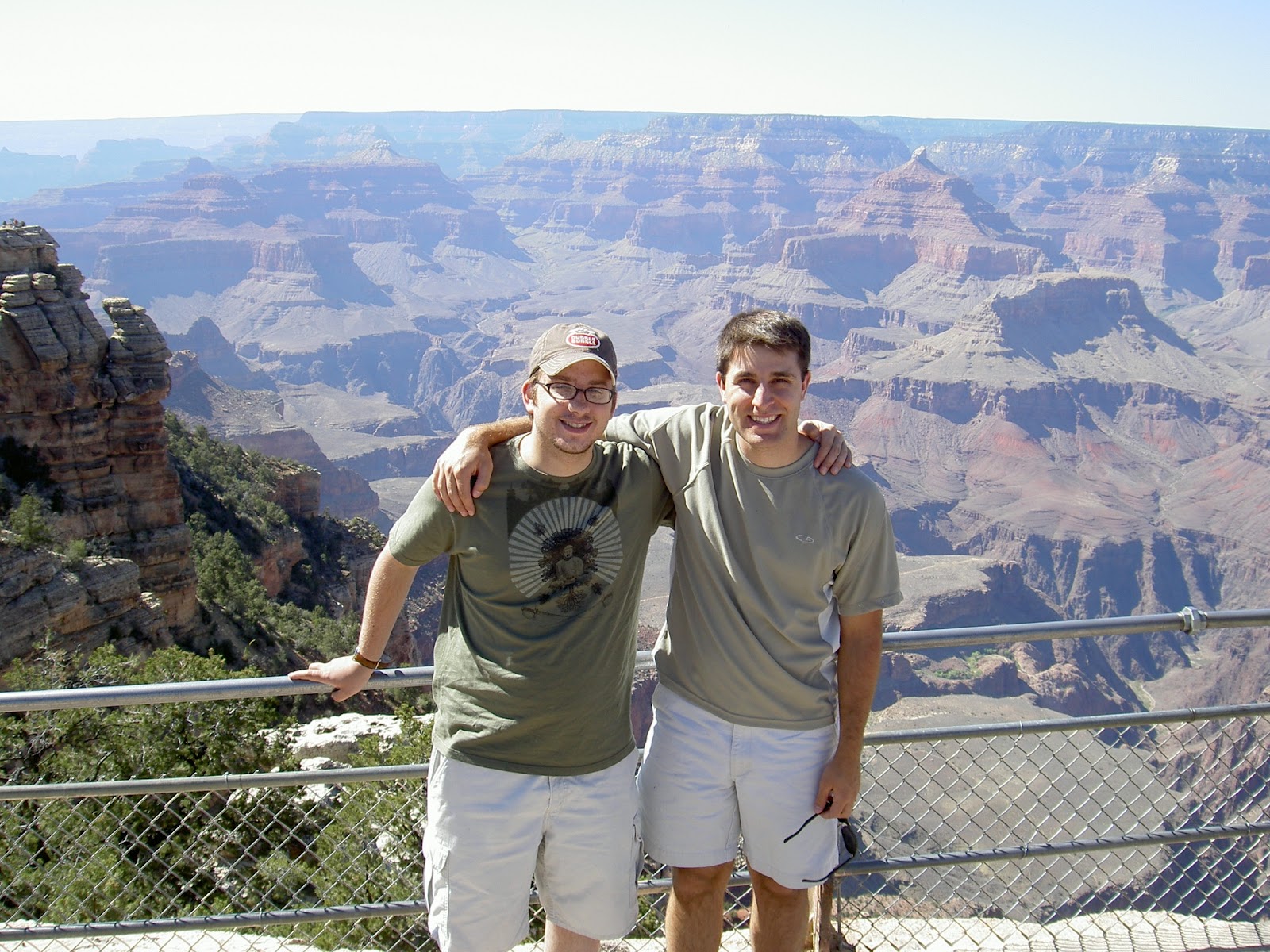
| Matt and I at the Grand Canyon, 2007 |
Matthew Bednarz is one of those extremely rare people who actually has loads of wisdom and love. He's the kind of person who can read the subtext in life. He's able to bring out its humor, joy, and worth--and he's been doing that for me ever since we were in the Cub Scouts at age five.
We rose, together, through the ranks of John F. Kennedy Elementary School and what I remember most about Matt is his incredible ability to make others laugh. But Matt was unique in that he didn't make people laugh at other people--instead, Matt just made people laugh. Anybody. Everybody. Matt could find the humor in any situation, whether it was discussing the small cartons of chocolate milk or the onset of puberty and the realization of girls. Matt's quick wit was evident to all of us, and my stomach often ached with joy whenever I was with him for more than five minutes (which was often).
But Matt's humor was only the beginning. because his ability to make people laugh was grounded in something even more rare: his wisdom about people and the world around him. Matt was able to see the good in everybody--and I mean everybody. he would talk with anyone, share with anyone, listen to anyone.
And Matt could write (can write). His stories, in elementary school, always evidenced something that made the rest of us say,. "Isn't Matt our age? How can he write like that?" And we'd listen to him read something he wrote or talk about a story or movie idea of his, and we'd elbow one another and think, Damn, that's really, really, really awesome the way that only fifth-graders can.
We both had Mr. Robert Looney as our teacher in fifth grade--a man who deserves a medal and his own tribute for the inspiration and joy he shared with us--and that year Matt and I were encouraged to write wildly creative and free stories. So, we did so. What we'd once penned as "Voyagers" in the second and third grades became even zanier and more twisted now. And all the while, Matt was visualizing how to film things, how to bring stories to life in a way that no one else I knew even talked about.
On weekends, Matt would hoist the large VHS camcorder onto his shoulder, pass out scripts to his other Cub Scout friends (now we'd moved on from the scouts but still got together regularly), and he'd guide us in his own self-written, self-produced, self-directed, self-edited movies. (They were, of course, always awesome). Whether it was a movie about Mars Bar and Almond Joy--anthropomorphized into mafia-esque men at battle for power--or the nuances of young love, Matt's movies always had one central message: life can be hard, crazy, unexpected, painful, weird, confusing--but it's always, always worth living 9and living to the fullest).
As we entered high school,. the characters in Matt's movies and stories grew more complex--and the stakes within the scripts were raised--but that central message remained: that life, for all its horror and pain, is still worth it. Life is still amazing, even if it's nearly impossible to see it that way sometimes. The characters in Matt's stories and movies--like Matt himself--always chose to fight on, to embody courage towards whatever they faced.
And in this regard, they always succeeded, because they always kept on going.
When Jennifer and I moved to Flagstaff in 2006, after I'd left high school teaching to go back to school for a couple of years, Matt flew out to visit and spend five days with us. We saw a lot, talked a lot, did a lot. But what I remember most about that trip was a single moment: we were outside Jen and I's little campus apartment, and the unequaled Ponderosa Pines surrounded us. I looked up at Matt, and it was like I could still still the five-year old friend with whom I played kick ball, whose jokes I laughed at till my stomach revolted against me, whose generosity of spirit, warmth, and creativity had grabbed hold of me and inspired me even then. And I looked at Matt, and it was like the 21 years that had passed from our Cub Scout days until then hadn't changed a thing.
Not at all.
Instead, we were both five-year olds, still, albeit with harrier faces, a few more battle scars. But we still saw that thing inside one another that only a friend who's known you since you were five even can see: your character arc. Your journey. Every protagonist needs to face incredible odds in order for his story to become beautiful.
In this manner, Matthew Bednarz becomes even more than an incredible protagonist. because his story isn't only about him and the odds he's had to face. Instead, it's about me, too, and every other person on whom he's had a remarkable impact through his laughter, his wisdom, his creativity, and his love.
Today, I say happy birthday to my best friend and a guy whose character arc is, to me, amazing. I'm grateful that you've let me be a part of it for so long. And I look forward to the stories still to be told, the movies still to be made, the laughter still to be had. I love you, friend.
Friday, March 30, 2012
An Interview with Author Tara Lazar
Already, Tara Lazar has made an indelible mark on the world of picture books--both via publishing and also by helping to inspire others as we craft and create. As the founder of PiBoIdMo, the equivalent to National Novel Writing Month for picture book writers, Tara is steeped in wisdom, passion, and perseverence. She currently has two picture books slated for publication, both from Aladdin / Simon and Schuster: THE MONSTORE (coming in 2013) in I THOUGHT THIS WAS A BEAR BOOK (coming in 2014). Her witty and wise blog, Writing for Kids (While Raising Them) features Tara's engaging writing style, great interviews and guest bloggers, and already has 982 followers. I'm deeply delighted to welcome Tara to Intersections today as she shares her inspiring journey with us!
Where and how did you first conceive of the idea for your first picture book now under contract with Aladdin/Simon and Schuster, THE MONSTORE?
I love word play. I spew out phrases like "picture book palooza" and "ballyhoo of boisterous beasts". So one day the title THE MONSTORE just came to me. I can't think of anything particularly special about that moment. But I had that title in my brain for several months before I ever did anything with it.
I had made friends with author and agent Jill Corcoran via social media and had the pleasure of meeting her in person at the 2009 NJ-SCBWI annual conference. I asked her if she would look at my picture book premises and suggest which might be the best ones to pursue as manuscripts. As I was writing up that email, I realized I had NO PREMISE for THE MONSTORE. So I quickly devised one: "A boy wants to return the monster he bought because it doesn't spook his little sister." Jill told me it was a winner. But I still didn't write it.
Then one day I just sat down and pumped it out. It flew from my fingertips. Everything just fell into place, from the "no returns, no exchanges" refrain to the perfect ending (which I won't reveal). My friend and critique partner Corey Rosen Schwartz read it an said "this will sell"! And I should mention that Corey has super-accurate publishing radar.
Can you share about your personal journey towards your current passion for picture books?
My journey began when I was very young. As soon as I was able to write, I was telling stories. When teachers announced we had a creative writing project, I literally cheered (I kept pom-poms in my desk). When I was about 8 years old, my friend Francine and I wrote a picture book. We lied and said it was published. Too funny. But I do remember reading Ally Sheedy's "She Was Nice to Mice" over and over again and realizing it was published by a KID. She was only 12 years old. If she could do it, I could. So I kept writing.
In high school I got in trouble for my creative writing. I wrote a scathing story about all the populars that went viral in the old-fashioned way: read for a buck in the bathroom. The story was such a hit that my AP History teacher read it to all his classes. It didn't have my name on it, but everyone knew it was my doing.
I used to meet with my 10th grade English teacher to talk about writing but I really didn't know what I was doing back then. I just wrote without any structure. That she actually read my drivel and encouraged me was miraculous.
In college I studied English and Creative Writing and it was my intention to work in children's publishing. But when I graduated and I had to take whatever job I could find, and jobs were scarce. I landed in computer books and quickly grew bored. My career then veered toward high-tech and it wasn't until I was pregnant with my second daughter that I finally decided it was time to pursue my life-long goal of becoming a children's author. That was in 2006 and I joined a kidlit critique group. I took a year off once my daughter was born and got really serious in late 2007. I started my blog, began attending events, and read craft books. In 2008 I was accepted to the RUCCL conference and that's when I knew I maybe had what it takes. And I am thrilled to report that I'll be the "success story" speaker at this year's RUCCL conference! Somebody pinch me!
How did you respond to rejections you may have received while submitting both THE MONSTORE and I THOUGHT THIS WAS A BEAR BOOK?
I was lucky because THE MONSTORE didn't receive many rejections, but that's because I didn't send it out many places. In January 2010 I submitted it to a NJ-SCBWI Mentor Conference but got very sick and couldn't attend. The organizers sent the editor critique to me anyway. When I got the envelope is was very thick and I thought, "Great. The editor hated it." So I didn't even touch it for a week! When I finally did zip it open, I saw lots of bullet points. But they were GOOD bullet points like, "Love the title and the premise. I was hooked on the first page." I couldn't believe it. She asked to see again it once I had revised.
That's when I thought it was time to get an agent. One agent got back to me right away with a "no" but said "I think this will sell, definitely." So that gave me another boost of confidence. I revised again, making the story stronger.
In the meantime, Corey had won a critique from author Jean Reidy and didn't have anything to send, so she sent THE MONSTORE. Jean loved it and tweeted about it. Ammi-Joan Paquette, who is an author and agent, saw the tweet and asked about the manuscript. So I received a referral to Joan, with whom I clicked immediately. I had other agents interested, too, but they had declined for various reasons---too similar to an existing client's work, not interested in my other manuscripts. I signed with Joan at the end of March 2010.
I THOUGHT THIS WAS A BEAR BOOK never got a rejection. It was a lucky score with my current editor. She loved the premise and I did a revision for her before going to acquisitions. But she did decline other projects I submitted between MONSTORE and BEAR. One of those projects is elsewhere waiting for a green light.
If you could share any advice with people in the following categories, what would you say to:
Writers: Go with your gut instinct.
Parents: Go with your gut instinct.
Teachers: I hate quotations. Tell me what you know.
12-year olds: Don't be in a rush to become an adult. It's not better than being 12. Nothing's better than being 12.
Finally, can you share some of your most joyful and fun aspects of the writing process, and some of your most difficult parts?
The most joyful times are when I start a project full of hope and the best intentions. I get excited about new ideas with high-concept potential.
The most difficult part is when those stories just don't turn out the way you expected them to. I have a fabulous premise, but the right story for the setting and characters hasn't yet emerged. I'm on my fourth major rewrite. It can be very frustrating. I know this could be a hit and I'm eager to get it out there, but I also have to be patient and make sure I get it right.
Thanks for sharing your journey with us, Tara, and I am gleefully giddy about the release of both your books. THE MONSTORE and I THOUGHT THIS WAS A BEAR BOOK will both become well-read books in our home!
Where and how did you first conceive of the idea for your first picture book now under contract with Aladdin/Simon and Schuster, THE MONSTORE?
I love word play. I spew out phrases like "picture book palooza" and "ballyhoo of boisterous beasts". So one day the title THE MONSTORE just came to me. I can't think of anything particularly special about that moment. But I had that title in my brain for several months before I ever did anything with it.
I had made friends with author and agent Jill Corcoran via social media and had the pleasure of meeting her in person at the 2009 NJ-SCBWI annual conference. I asked her if she would look at my picture book premises and suggest which might be the best ones to pursue as manuscripts. As I was writing up that email, I realized I had NO PREMISE for THE MONSTORE. So I quickly devised one: "A boy wants to return the monster he bought because it doesn't spook his little sister." Jill told me it was a winner. But I still didn't write it.
Then one day I just sat down and pumped it out. It flew from my fingertips. Everything just fell into place, from the "no returns, no exchanges" refrain to the perfect ending (which I won't reveal). My friend and critique partner Corey Rosen Schwartz read it an said "this will sell"! And I should mention that Corey has super-accurate publishing radar.
Can you share about your personal journey towards your current passion for picture books?
My journey began when I was very young. As soon as I was able to write, I was telling stories. When teachers announced we had a creative writing project, I literally cheered (I kept pom-poms in my desk). When I was about 8 years old, my friend Francine and I wrote a picture book. We lied and said it was published. Too funny. But I do remember reading Ally Sheedy's "She Was Nice to Mice" over and over again and realizing it was published by a KID. She was only 12 years old. If she could do it, I could. So I kept writing.
In high school I got in trouble for my creative writing. I wrote a scathing story about all the populars that went viral in the old-fashioned way: read for a buck in the bathroom. The story was such a hit that my AP History teacher read it to all his classes. It didn't have my name on it, but everyone knew it was my doing.
I used to meet with my 10th grade English teacher to talk about writing but I really didn't know what I was doing back then. I just wrote without any structure. That she actually read my drivel and encouraged me was miraculous.
In college I studied English and Creative Writing and it was my intention to work in children's publishing. But when I graduated and I had to take whatever job I could find, and jobs were scarce. I landed in computer books and quickly grew bored. My career then veered toward high-tech and it wasn't until I was pregnant with my second daughter that I finally decided it was time to pursue my life-long goal of becoming a children's author. That was in 2006 and I joined a kidlit critique group. I took a year off once my daughter was born and got really serious in late 2007. I started my blog, began attending events, and read craft books. In 2008 I was accepted to the RUCCL conference and that's when I knew I maybe had what it takes. And I am thrilled to report that I'll be the "success story" speaker at this year's RUCCL conference! Somebody pinch me!
How did you respond to rejections you may have received while submitting both THE MONSTORE and I THOUGHT THIS WAS A BEAR BOOK?
I was lucky because THE MONSTORE didn't receive many rejections, but that's because I didn't send it out many places. In January 2010 I submitted it to a NJ-SCBWI Mentor Conference but got very sick and couldn't attend. The organizers sent the editor critique to me anyway. When I got the envelope is was very thick and I thought, "Great. The editor hated it." So I didn't even touch it for a week! When I finally did zip it open, I saw lots of bullet points. But they were GOOD bullet points like, "Love the title and the premise. I was hooked on the first page." I couldn't believe it. She asked to see again it once I had revised.
That's when I thought it was time to get an agent. One agent got back to me right away with a "no" but said "I think this will sell, definitely." So that gave me another boost of confidence. I revised again, making the story stronger.
In the meantime, Corey had won a critique from author Jean Reidy and didn't have anything to send, so she sent THE MONSTORE. Jean loved it and tweeted about it. Ammi-Joan Paquette, who is an author and agent, saw the tweet and asked about the manuscript. So I received a referral to Joan, with whom I clicked immediately. I had other agents interested, too, but they had declined for various reasons---too similar to an existing client's work, not interested in my other manuscripts. I signed with Joan at the end of March 2010.
I THOUGHT THIS WAS A BEAR BOOK never got a rejection. It was a lucky score with my current editor. She loved the premise and I did a revision for her before going to acquisitions. But she did decline other projects I submitted between MONSTORE and BEAR. One of those projects is elsewhere waiting for a green light.
If you could share any advice with people in the following categories, what would you say to:
Writers: Go with your gut instinct.
Parents: Go with your gut instinct.
Teachers: I hate quotations. Tell me what you know.
12-year olds: Don't be in a rush to become an adult. It's not better than being 12. Nothing's better than being 12.
Finally, can you share some of your most joyful and fun aspects of the writing process, and some of your most difficult parts?
The most joyful times are when I start a project full of hope and the best intentions. I get excited about new ideas with high-concept potential.
The most difficult part is when those stories just don't turn out the way you expected them to. I have a fabulous premise, but the right story for the setting and characters hasn't yet emerged. I'm on my fourth major rewrite. It can be very frustrating. I know this could be a hit and I'm eager to get it out there, but I also have to be patient and make sure I get it right.
Thanks for sharing your journey with us, Tara, and I am gleefully giddy about the release of both your books. THE MONSTORE and I THOUGHT THIS WAS A BEAR BOOK will both become well-read books in our home!
Thursday, February 16, 2012
The Perks of Living in a Brick House
Besides being a time-tested detriment to the Big Bad Wolf, living in a brick house has other fringe benefits.
Take, for instance, the fact that bricks are red. And red feels, somehow, deep. That reddish hue that escapes narrow definition as a Valentine's Day heart or a tomato. Instead, it's that deep kind of red that makes you think, Dude, if this deep kind of red was a live human being, it would quite possibly be one of those human whom you know is constantly considering profound information and uncanny wisdom as it applies to essential life questions.
Take, as well, the fact that brick is a word with which much can rhyme. Therefore, as people who live in a brick home, we can feel quite free to rhyme our home with lots of other words as we craft spontaneous couplets and sing them loud and far and wide with our windows open, such as: This home is made of brick; / Our flu is gone, no longer sick! / We dance in delight while holding sticks, / Because--yes!--we live in a house made of bricks!
And even though the two aforementioned benefits of living in a brick house are formidable and even hard to swallow on the first read-through (or at least fully digest), here is, perhaps, the greatest perk of them all--one for which pictures will have to suffice, since, as the old adage goes: a picture is worth a lot of words, maybe even one-hundred words, or even one hundred words plus an awful lot more words.
Take, for instance, the fact that bricks are red. And red feels, somehow, deep. That reddish hue that escapes narrow definition as a Valentine's Day heart or a tomato. Instead, it's that deep kind of red that makes you think, Dude, if this deep kind of red was a live human being, it would quite possibly be one of those human whom you know is constantly considering profound information and uncanny wisdom as it applies to essential life questions.
Take, as well, the fact that brick is a word with which much can rhyme. Therefore, as people who live in a brick home, we can feel quite free to rhyme our home with lots of other words as we craft spontaneous couplets and sing them loud and far and wide with our windows open, such as: This home is made of brick; / Our flu is gone, no longer sick! / We dance in delight while holding sticks, / Because--yes!--we live in a house made of bricks!
And even though the two aforementioned benefits of living in a brick house are formidable and even hard to swallow on the first read-through (or at least fully digest), here is, perhaps, the greatest perk of them all--one for which pictures will have to suffice, since, as the old adage goes: a picture is worth a lot of words, maybe even one-hundred words, or even one hundred words plus an awful lot more words.
Labels:
Creativity,
imagination,
Jennifer,
joy,
Love,
parenting,
Tyler,
York
Tuesday, February 14, 2012
The Sunflower Sword
Inspired by Mark Sperring's and Miriam Latimer's remarkable book, The Sunflower Sword, Jennifer and Tyler made good on Robert Frost's definition of poetry: "words that become deeds." See Jen's post about the book, on how she and Tyler brought it to life, and the awesome pictures here.
Sunday, February 12, 2012
Creating from a Place of Compassion and Love
I first met my good friend Wade Austin when Jennifer and I moved to Flagstaff, Arizona from 2006-2008. One of those rare people who exudes both authenticity and joy, Wade has since been a remarkable friend, brother, encourager, challenger, and someone whom I deeply admire. In addition to many other talents and abilities, Wade is a gifted pianist and composer. Recently, I asked Wade if he could respond to some questions about his process of creation and creativity, as well as share some of his originally composed music (three YouTube videos follow the interview).
What inspires you most to create music?
Wow, great question: I would say several things inspire me. 1) Is hearing good music. When I hear good music, I ask myself and analyze what about that song do I like. For example it could be a good chord progression or an impressive melody, or excellent use of tension and release. Than I try to use it in my own music. 2) I also feel inspired when someone needs something. For example, if one of my friends needs a song for their wedding, or if they need a song to help them through a hard time. I feel very inspired to write.
When did you first fall in love with writing music?
I believe that in high school I first fell in love with writing music. While most people stand on the earth and watch the sun rise, I believe artists stand on the moon and watch the earth rise. It is a double edge sword, because artists get a unique perspective of the world, but they also tend to feel alone and misunderstood. Music allowed me to express hidden feelings and also share my perspective. In grief there is so much beauty. I believe that there is such a thin line between pure beauty and grief, and music walks that line perfectly. This is the aspect of music that I fell most in love with.
Can you share a story about a song you've written and the personal experiences out of which it arose?
There is a song I wrote for a wedding. The bride to be lost her brother and I felt like she really wished that her brother could be there. So, in this song I told a story about a woman/the bride who has a deep pain and she is embarrassed to bring this pain into the marriage. Later the fiance says I have pain of my own and I understand how you feel but with my strength I will carry your burden. In the future, the husband has his own burden, but the wife is free of her pain, but she never forgets. I can't play that song without tears coming to my eyes. It also reminds me of how God loves us. Despite whatever we bring to the relationship he loves us anyway. He also helps us get through our deepest grief.
What are your greatest joys and deepest lows when you work on music?
My greatest joy about music is seeing someone heal because of the music I was inspired to write. My greatest joy is when someone says, "I know exactly what that song meant," or "that song helped me through this hard time." My deepest low is when I struggle with feelings of inadequacy. I feel like the music I write is stupid, or people think that I am an amateur writer. It's difficult to compose when those feelings are haunting your mind.
What advice would you share with others who aspire to write music and share their work with audiences?
I would say never quit. Make sure that you always write for yourself. It is tempting to write something that will be popular or that people will like. I guess that is necessary sometimes, but always write something that you enjoy and blesses you.
Can you tell us about the song(s) to which the link or links go?
I put three songs on the web, and they are all songs that I wrote for my wife. They are all about different times of her life.
One of the songs is called "Orphaned Child." This song has special meaning because this is one of the songs to which we first fell in love. She asked me to write music to lyrics she wrote. After I shared the song with her, it blessed her tremendously. It was a crazy spiritual connection. We later walked down the aisle to that song.
The second song is called "Southern Belle." This song captures her experience as a missionary in Louisiana.
The third song is called "Celeste Movement I." This song captures a time in her life when she lost a good friend of hers in a car accident.
"Orphaned Child"
"Southern Belle"
"Celeste Movement I"
What inspires you most to create music?
Wow, great question: I would say several things inspire me. 1) Is hearing good music. When I hear good music, I ask myself and analyze what about that song do I like. For example it could be a good chord progression or an impressive melody, or excellent use of tension and release. Than I try to use it in my own music. 2) I also feel inspired when someone needs something. For example, if one of my friends needs a song for their wedding, or if they need a song to help them through a hard time. I feel very inspired to write.
When did you first fall in love with writing music?
I believe that in high school I first fell in love with writing music. While most people stand on the earth and watch the sun rise, I believe artists stand on the moon and watch the earth rise. It is a double edge sword, because artists get a unique perspective of the world, but they also tend to feel alone and misunderstood. Music allowed me to express hidden feelings and also share my perspective. In grief there is so much beauty. I believe that there is such a thin line between pure beauty and grief, and music walks that line perfectly. This is the aspect of music that I fell most in love with.
Can you share a story about a song you've written and the personal experiences out of which it arose?
There is a song I wrote for a wedding. The bride to be lost her brother and I felt like she really wished that her brother could be there. So, in this song I told a story about a woman/the bride who has a deep pain and she is embarrassed to bring this pain into the marriage. Later the fiance says I have pain of my own and I understand how you feel but with my strength I will carry your burden. In the future, the husband has his own burden, but the wife is free of her pain, but she never forgets. I can't play that song without tears coming to my eyes. It also reminds me of how God loves us. Despite whatever we bring to the relationship he loves us anyway. He also helps us get through our deepest grief.
What are your greatest joys and deepest lows when you work on music?
My greatest joy about music is seeing someone heal because of the music I was inspired to write. My greatest joy is when someone says, "I know exactly what that song meant," or "that song helped me through this hard time." My deepest low is when I struggle with feelings of inadequacy. I feel like the music I write is stupid, or people think that I am an amateur writer. It's difficult to compose when those feelings are haunting your mind.
What advice would you share with others who aspire to write music and share their work with audiences?
I would say never quit. Make sure that you always write for yourself. It is tempting to write something that will be popular or that people will like. I guess that is necessary sometimes, but always write something that you enjoy and blesses you.
Can you tell us about the song(s) to which the link or links go?
I put three songs on the web, and they are all songs that I wrote for my wife. They are all about different times of her life.
One of the songs is called "Orphaned Child." This song has special meaning because this is one of the songs to which we first fell in love. She asked me to write music to lyrics she wrote. After I shared the song with her, it blessed her tremendously. It was a crazy spiritual connection. We later walked down the aisle to that song.
The second song is called "Southern Belle." This song captures her experience as a missionary in Louisiana.
The third song is called "Celeste Movement I." This song captures a time in her life when she lost a good friend of hers in a car accident.
"Orphaned Child"
"Southern Belle"
"Celeste Movement I"
Labels:
Creativity,
friendship,
hope,
music,
perseverance,
piano,
Wade Austin,
Writing
Monday, December 26, 2011
Hemojababala
Today, we hit fifty-six degrees. In England. In York. On December 26. Fifty-six degrees.
And in honor of this remarkable occurrence, Tyler and I went to nearby Rowntree Park on the bike-and-trailer. While there are swings, slides, rope ladders, more swings, more slides, and more rope ladders at Rowntree Park, Tyler found the most joy in having an intellectually stimulating conversation with an ancient man named Hemojababala.
You may have heard of Hemojababala. He's well-known in many parts of the world. I am somewhat ashamed to admit that I had not met him "officially" until today. Yet I always knew he existed. Knew it in that deep place inside of me where oatmeal chocolate chip cookies go to hibernate. Where water evaporates. Where you can stretch out your intestines to incredible lengths.
Hemojababala is known for many sage sayings, such as this one: If you are standing under an apple tree and you are hoping a mango will fall into your outstretched palms, and then you look up at the sky and lightning flashes, and then you hear thunder, then you had better get inside, because being outside in a thunderstorm while standing under an apple tree (or any tree for that matter) is a very bad idea.
But Hemojababala is perhaps best known for his ability to reason with toddlers. Some have called him the Toddler Whisperer, while others have simply called him Weirdo.
I include the following real-action footage of Tyler's discussion with Hemojababala today so that you can make your own, educated decision.
And in honor of this remarkable occurrence, Tyler and I went to nearby Rowntree Park on the bike-and-trailer. While there are swings, slides, rope ladders, more swings, more slides, and more rope ladders at Rowntree Park, Tyler found the most joy in having an intellectually stimulating conversation with an ancient man named Hemojababala.
You may have heard of Hemojababala. He's well-known in many parts of the world. I am somewhat ashamed to admit that I had not met him "officially" until today. Yet I always knew he existed. Knew it in that deep place inside of me where oatmeal chocolate chip cookies go to hibernate. Where water evaporates. Where you can stretch out your intestines to incredible lengths.
Hemojababala is known for many sage sayings, such as this one: If you are standing under an apple tree and you are hoping a mango will fall into your outstretched palms, and then you look up at the sky and lightning flashes, and then you hear thunder, then you had better get inside, because being outside in a thunderstorm while standing under an apple tree (or any tree for that matter) is a very bad idea.
But Hemojababala is perhaps best known for his ability to reason with toddlers. Some have called him the Toddler Whisperer, while others have simply called him Weirdo.
I include the following real-action footage of Tyler's discussion with Hemojababala today so that you can make your own, educated decision.
Monday, November 28, 2011
Charlie McNarry Has a Query
Yolanda Mews has exciting news:
"Anything times zero is zero!"
The teacher nods, munches pretzel rods,
Says, "But don't think you're some kind of hero."
Beatrice Shelly has a pain in her belly.
"I need to go to the nurse!"
The teacher's head shakes, he eats his cakes,
Says, "Not until you're much, much worse!"
Charlie McNarry has a query:
"What makes the sky so blue?"
The teacher sighs and east his fries,
Says, "Does the sky ever ask about you?"
Phil Brigands has a worm in his hands:
"Look, it's so slimy and cool!"
The teacher yells, belches taco shells,
Says, "Touch it again and you're out of this school!"
A few weeks pass; teacher has gas.
"Oh, my poor poor belly is aching!"
He falls to the ground, sees a worm sitting down.
The ache makes him cry, look up at the sky.
He pleads for a hero to make the pain equal zero.
Charlie and Beatrice, Yolanda and Phil
Go down to the nurse and get him a pill.
Teacher says thank you, teacher feels great.
That night, at home, teacher stays up late.
A book lays on his lap as he falls asleep:
The Science of the Sky is one he'll keep.
"Anything times zero is zero!"
The teacher nods, munches pretzel rods,
Says, "But don't think you're some kind of hero."
Beatrice Shelly has a pain in her belly.
"I need to go to the nurse!"
The teacher's head shakes, he eats his cakes,
Says, "Not until you're much, much worse!"
Charlie McNarry has a query:
"What makes the sky so blue?"
The teacher sighs and east his fries,
Says, "Does the sky ever ask about you?"
Phil Brigands has a worm in his hands:
"Look, it's so slimy and cool!"
The teacher yells, belches taco shells,
Says, "Touch it again and you're out of this school!"
A few weeks pass; teacher has gas.
"Oh, my poor poor belly is aching!"
He falls to the ground, sees a worm sitting down.
The ache makes him cry, look up at the sky.
He pleads for a hero to make the pain equal zero.
Charlie and Beatrice, Yolanda and Phil
Go down to the nurse and get him a pill.
Teacher says thank you, teacher feels great.
That night, at home, teacher stays up late.
A book lays on his lap as he falls asleep:
The Science of the Sky is one he'll keep.
Tuesday, November 22, 2011
Staying Burned IN
A few years ago, I became consumed with the question, how do we stay "burned in" to our work as teachers? I wanted to get a feel for what others had to say about sustaining energy, joy, and hope in a profession that carries its share of obstacles and challenges.
The result of that question was a volume to which many of the educators I most admire contributed: Burned In: Fueling the Fire to Teach.
But I see that the question of staying "burned in" is a question that applies to all of us--whether we are teachers or writers or parents or chefs or postal carriers or pool cleaners or salmon fishers or scuba diving instructors or sculptors. How do we all stay burned in?
So it was with tail-wagging glee that I read my wife, Jennifer's, latest blog: "Getting Lost in the Creativity of Work." She includes some pretty potent wisdom, as well as two awesome YouTube clips. Well worth reading!
The result of that question was a volume to which many of the educators I most admire contributed: Burned In: Fueling the Fire to Teach.
But I see that the question of staying "burned in" is a question that applies to all of us--whether we are teachers or writers or parents or chefs or postal carriers or pool cleaners or salmon fishers or scuba diving instructors or sculptors. How do we all stay burned in?
So it was with tail-wagging glee that I read my wife, Jennifer's, latest blog: "Getting Lost in the Creativity of Work." She includes some pretty potent wisdom, as well as two awesome YouTube clips. Well worth reading!
Tuesday, October 18, 2011
Writing with Enthusiasm
Say that something's in the air: the changing of seasons, exhaust from the cars, baby gifts to the world as strollers (aka buggies) whirl past our little home on Lesley Avenue. Whatever the case, enthusiasm has been my best friend lately.
There are those days when the writing feels hard to begin. When e-mail seems a lot more exciting, or easier, and reworking that MG manuscript or picture book idea for the 21st time doesn't doesn't seem to possess the YES! that it sometimes does.
This past year in England, though, writing has become more of a Show Up endeavor. Specifically, this process of writing not by emotion but by will entails two parts:
1. Show up.
2. Write.
The more I show up at the computer each morning, afternoon, or night (depending on Tyler's sleep schedule), the more the Emotion, the Inspiration, and the YES! decide to join me. In other words, once those Lovely Three start to learn, hey, this guy's going to write his brains and heart out no matter what, it's like they decide, Okay, well, if he's that loyal, let's go give the guy some company.
And lately, enthusiasm has been pounding through my heart and fingers--even when I haven't recently poured myself a cup of strong-beyond-belief coffee.
Take today, for instance. After dropping Tyler off at pre-school this afternoon, I came home and went straight up to the computer. Before I checked e-mail--always the culprit that sucks time like a Hepa-Filter-Super-Powered-Vacuum-Cleaner--I opened up my MG work-in-progress, Fortress (about a Muilsim boy, a Jewish girl, a Christian owner of an old, falling-apart movie theater, a Grandmother with Alzheimer's who, only at three a.m., is struck coherent and relates a story about York, England from 1198 that involves King Richard the First, Robin Hood, the Crusades, and a little girl named Liljiana who loves flowers).
I wrote and I wrote and I wrote.
I wrote like my characters were no longer characters. As though the letters of my keyboard were very, very tiny orange lifesaving floats that I had to furiously press repeatedly to get them to reach the characters but then--
Oh no!
Something would inevitably happen and my characters had to find out how to deal with the new storm, the new joy, the new complexity.
All that to say, this afternoon, writing was not writing. Writing was living for a group of people whom I could watch being created by fingers that moved across the keyboard that were not my own.
I wish every writing day could be like today. But the ones that are not hold their own beauty, their own excitement. (Even if that excitement only happens to be a single line that is made right after forty attempts at the sucker.)
But man, I sure an grateful for days like today: when emotion and will mix and create one heck of a little baby.
There are those days when the writing feels hard to begin. When e-mail seems a lot more exciting, or easier, and reworking that MG manuscript or picture book idea for the 21st time doesn't doesn't seem to possess the YES! that it sometimes does.
This past year in England, though, writing has become more of a Show Up endeavor. Specifically, this process of writing not by emotion but by will entails two parts:
1. Show up.
2. Write.
The more I show up at the computer each morning, afternoon, or night (depending on Tyler's sleep schedule), the more the Emotion, the Inspiration, and the YES! decide to join me. In other words, once those Lovely Three start to learn, hey, this guy's going to write his brains and heart out no matter what, it's like they decide, Okay, well, if he's that loyal, let's go give the guy some company.
And lately, enthusiasm has been pounding through my heart and fingers--even when I haven't recently poured myself a cup of strong-beyond-belief coffee.
Take today, for instance. After dropping Tyler off at pre-school this afternoon, I came home and went straight up to the computer. Before I checked e-mail--always the culprit that sucks time like a Hepa-Filter-Super-Powered-Vacuum-Cleaner--I opened up my MG work-in-progress, Fortress (about a Muilsim boy, a Jewish girl, a Christian owner of an old, falling-apart movie theater, a Grandmother with Alzheimer's who, only at three a.m., is struck coherent and relates a story about York, England from 1198 that involves King Richard the First, Robin Hood, the Crusades, and a little girl named Liljiana who loves flowers).
I wrote and I wrote and I wrote.
I wrote like my characters were no longer characters. As though the letters of my keyboard were very, very tiny orange lifesaving floats that I had to furiously press repeatedly to get them to reach the characters but then--
Oh no!
Something would inevitably happen and my characters had to find out how to deal with the new storm, the new joy, the new complexity.
All that to say, this afternoon, writing was not writing. Writing was living for a group of people whom I could watch being created by fingers that moved across the keyboard that were not my own.
I wish every writing day could be like today. But the ones that are not hold their own beauty, their own excitement. (Even if that excitement only happens to be a single line that is made right after forty attempts at the sucker.)
But man, I sure an grateful for days like today: when emotion and will mix and create one heck of a little baby.
Labels:
creation,
Creativity,
perseverance,
Surrender,
Writing,
York
Friday, April 15, 2011
On Finishing
Finish. To finish. Finishing. The more I type and say this word, the more I think of a Finnish man pulling a large trout out of the water, which is an immensely gross and biased interpretation of what Finnish men (or women) actually do. (Please feel free to enlighten me, any Finnish readers!)
But the word is now rumbling around in my brain since I just put the last touches on a manuscript and sent it off to Teachers College Press. A Call to Creativity: Writing, Reading, and Growing with Students in an Age of Standardization (working title) is a manuscript whose pages are filled with all that my students taught me, and so many of the goofy, silly, meaningful, growing, and (yes) weird experiences we forged through together.
And in finishing (at least until the major revisions come back from the editor), there is a certain feeling of lightness, of hope, of belief that maybe something in the book will connect with other teachers who will then use the material with their own students (who will hopefully connect with something, who will then...). In a stage like this--where a manuscript is semi-finished and nothing more can be done until revisions arrive--the room for hope and possibility is large.
It's like arriving at a buffet and looking at the massive table of food while feeling one's tummy groan in gleeful anticipation. Or it's like looking out at a large field before you decide to run wildly across it, pretending first to be an ogre, second to be a superhero, and third to be yourself, strangest of all. Or it's like drinking a very tall glass of water and then putting the glass down on the table in front of you and watching the tiny drops that fall back down the sides.
Finishing feels good. Certainly.
But the learning curve I'm on lately admonishes me to not focus too much on finishing. The character arc in which I find myself in this chapter of life has me headed towards: Focus on delighting in the present, in the journey of the work, the play, the complexity, the hope, the possiblity rather than the finishing of something.
And this is especially difficult for me because I absolutely love finishing. I love getting to the end of something and embraces that feeling of satisfaction that arrives. (Cut to scene: Satisfaction and I run towards one another on a beach, lit by the setting sun, while a powerful yet not too intense instrumental piece comes on background; a lone seagull shoots across the wavering waves of sun-heat; Satisfaction and I embrace.)
But I am seeing more and more that Satisfaction doesn't often linger long. Even though I try to persuade Satisfaction to hang out longer, offering him a cup of coffee, some green seedless grapes, or some yellow construction paper, he always makes some excuse and says he must be on his way.
And then finishing doesn't feel so good. Then, finishing feels more like leaving the buffet, feeling far too full and wondering why you went up for that last plate of green Jell-O. Or it feels like tripping over an unseen mound of dirt hidden by the tall grass of the field through which you were so movie-esquely running. Or it feels like inquenchable thirst even after that tall glass of water.
Once Satisfaction departs, the old longing to finish something else arrives. That inexhaustable voice of What Now?
So into this realm of finishing-related-emotions-and-thoughts, I was deeply grateful for the interruption of Dallas Willard. Not the writer himself, of course (though that would indeed be fantastically cool to receive a call from a great writer who began our phone conversation by uttering, "Hey, Luke, I just thought of calling you because I wondered if one of my ideas might offer you some food for thought in this character arc of your current journey...").
But Willard spoke nonetheless thorugh his volume, Revolution of Character. In an insightful chapter entitled, "Educating Our Emotions," Willard offers the insight that pleasure is fleeting; satusfaction arrives and is connected only to specific events, actions, or circumstances. As soon as those circumstances change, said pleasure and satisfaction changes, too. (Read: finishing!)
However, Willard continues, joy is something much more definite, much more associated with perception and permanency than with circumstances and situations. Joy is characterized as the choice to see the good. To see the good. Love, then, becomes the decision to act for the good of another outside yourself. (Whoa! I'm just trying to get beyond the circumstantial satisfaction of finishing, and here you are bringing up LOVE?!)
Joy doesn't fluctuate. Its life is more like the trunk of the tree than its leaves. Seasons come and go, but that stable body looks the same no matter how much snow or sun surrounds it.
When I watch my son Tyler, I see something of joy in him. Beyond the momentary and characteristic toddler tantrums (which, I am learning are indeed an important part of human-being growth, thank you to Mike Dunn!), Tyler displays an uncaany abillity to not care in the least about finishing something.
If Tyler is digging in the soil, he doesn't remark how good it will feel when all of the soil is finally dug up and he can go inside and sit at the kitchen table with a nice, cool drink.
If Tyler is cutting paper (as Jen has so expertly taught him to do), he doesn't discuss how wonderful it will be to finally cut all of the paper stocked in our entire home so that he can finally be done cutting paper and instead sit down and kick up his feet.
Finishing means nothing to my toddler. Not a thing. (Including such items as Finish your dinner! and Let's finish changing your poopie diaper before you jump on the bed!)
So, as I sit here having sent off my manuscript to the press, I'll conscientiously work to not feel too good about simply finishing it. Instead, I'll be trying to see this state as a step along the journey towards seeing what is good. A step in the journey of joy. And, God willing, this is how I'll respond tonight should Tyler wake up at two a.m. screaming because of a nightmare, or gas pains, or growing pains, or any number of other indecipherable reasons why a toddler wakes at two in the morning.
But I'm not finished with my need to work on re-defining finishing. Not by a long shot.
And hey, maybe that's a good thing after all.
But the word is now rumbling around in my brain since I just put the last touches on a manuscript and sent it off to Teachers College Press. A Call to Creativity: Writing, Reading, and Growing with Students in an Age of Standardization (working title) is a manuscript whose pages are filled with all that my students taught me, and so many of the goofy, silly, meaningful, growing, and (yes) weird experiences we forged through together.
And in finishing (at least until the major revisions come back from the editor), there is a certain feeling of lightness, of hope, of belief that maybe something in the book will connect with other teachers who will then use the material with their own students (who will hopefully connect with something, who will then...). In a stage like this--where a manuscript is semi-finished and nothing more can be done until revisions arrive--the room for hope and possibility is large.
It's like arriving at a buffet and looking at the massive table of food while feeling one's tummy groan in gleeful anticipation. Or it's like looking out at a large field before you decide to run wildly across it, pretending first to be an ogre, second to be a superhero, and third to be yourself, strangest of all. Or it's like drinking a very tall glass of water and then putting the glass down on the table in front of you and watching the tiny drops that fall back down the sides.
Finishing feels good. Certainly.
But the learning curve I'm on lately admonishes me to not focus too much on finishing. The character arc in which I find myself in this chapter of life has me headed towards: Focus on delighting in the present, in the journey of the work, the play, the complexity, the hope, the possiblity rather than the finishing of something.
And this is especially difficult for me because I absolutely love finishing. I love getting to the end of something and embraces that feeling of satisfaction that arrives. (Cut to scene: Satisfaction and I run towards one another on a beach, lit by the setting sun, while a powerful yet not too intense instrumental piece comes on background; a lone seagull shoots across the wavering waves of sun-heat; Satisfaction and I embrace.)
But I am seeing more and more that Satisfaction doesn't often linger long. Even though I try to persuade Satisfaction to hang out longer, offering him a cup of coffee, some green seedless grapes, or some yellow construction paper, he always makes some excuse and says he must be on his way.
And then finishing doesn't feel so good. Then, finishing feels more like leaving the buffet, feeling far too full and wondering why you went up for that last plate of green Jell-O. Or it feels like tripping over an unseen mound of dirt hidden by the tall grass of the field through which you were so movie-esquely running. Or it feels like inquenchable thirst even after that tall glass of water.
Once Satisfaction departs, the old longing to finish something else arrives. That inexhaustable voice of What Now?
So into this realm of finishing-related-emotions-and-thoughts, I was deeply grateful for the interruption of Dallas Willard. Not the writer himself, of course (though that would indeed be fantastically cool to receive a call from a great writer who began our phone conversation by uttering, "Hey, Luke, I just thought of calling you because I wondered if one of my ideas might offer you some food for thought in this character arc of your current journey...").
But Willard spoke nonetheless thorugh his volume, Revolution of Character. In an insightful chapter entitled, "Educating Our Emotions," Willard offers the insight that pleasure is fleeting; satusfaction arrives and is connected only to specific events, actions, or circumstances. As soon as those circumstances change, said pleasure and satisfaction changes, too. (Read: finishing!)
However, Willard continues, joy is something much more definite, much more associated with perception and permanency than with circumstances and situations. Joy is characterized as the choice to see the good. To see the good. Love, then, becomes the decision to act for the good of another outside yourself. (Whoa! I'm just trying to get beyond the circumstantial satisfaction of finishing, and here you are bringing up LOVE?!)
Joy doesn't fluctuate. Its life is more like the trunk of the tree than its leaves. Seasons come and go, but that stable body looks the same no matter how much snow or sun surrounds it.
When I watch my son Tyler, I see something of joy in him. Beyond the momentary and characteristic toddler tantrums (which, I am learning are indeed an important part of human-being growth, thank you to Mike Dunn!), Tyler displays an uncaany abillity to not care in the least about finishing something.
If Tyler is digging in the soil, he doesn't remark how good it will feel when all of the soil is finally dug up and he can go inside and sit at the kitchen table with a nice, cool drink.
If Tyler is cutting paper (as Jen has so expertly taught him to do), he doesn't discuss how wonderful it will be to finally cut all of the paper stocked in our entire home so that he can finally be done cutting paper and instead sit down and kick up his feet.
Finishing means nothing to my toddler. Not a thing. (Including such items as Finish your dinner! and Let's finish changing your poopie diaper before you jump on the bed!)
So, as I sit here having sent off my manuscript to the press, I'll conscientiously work to not feel too good about simply finishing it. Instead, I'll be trying to see this state as a step along the journey towards seeing what is good. A step in the journey of joy. And, God willing, this is how I'll respond tonight should Tyler wake up at two a.m. screaming because of a nightmare, or gas pains, or growing pains, or any number of other indecipherable reasons why a toddler wakes at two in the morning.
But I'm not finished with my need to work on re-defining finishing. Not by a long shot.
And hey, maybe that's a good thing after all.
Subscribe to:
Posts (Atom)