It was Lollipop Day--Thursday--yet the grocery shopping needed doing and Tyler and I needed a Morning Adventure. So: all the pieces fit. I decided I'd take Tyler to Aldi, the grocery store about seven and a half minutes walk from our home. The night before, Tyler hadn't slept well, and Jennifer and I had traded going-into-his-room duties back and forth until neither of us knew what time it was when another call for Mommy and Daddy rang out--only this: Your turn? No, my turn? Okay. My turn? No, your turn? Heaven Pie.
Now, it was eleven in the morning. Grocery shopping time for the little man and me.
The trip to Aldi was relatively uneventful: we saw people, said hello, saw more people, said hello to them, saw some teenagers who seemed like they were probably skipping school, said hello, got laughed at by them, laughed with them about being laughed at, then got a hello from the teens, a 'high five' from Tyler for the teens, and then onward Tyler biked through puddles that lay thick across the sidewalk en route. I jumped over the puddles. Tyler splashed through them, aglow.
We arrived. At Aldi.
And it was Lollipop Day, remember, which carried the designation of an entire day even though the act of purchasing a lollipop takes a mere minute. But in the beginning, I needed a way to designate days--to give Tyler and I a sense that Thursday--yes!--was far different from Monday. (Monday is Playgroup Day.)
So Tyler sat atop the grocery carriage and I pushed him around the store, grabbing the cheapest deals on Aldi-brand hummus, Aldi-brand bread, Aldi-brand baked beans, Aldi-brand free-range eggs, Aldi-brand juice, Aldi-brand frozen chicken breasts, Aldi-brand yogurt.
(We purchased other Aldi-brand items, which have all been excluded from this narrative so as to save us both useful time and mental clarity for a perspicacious look at what really matters here.)
So here's what really matters: the thing is, Aldi doesn't sell lollipops. (At least, last Thursday they didn't have a single licking lollipop available on the premises.) And it was Lollipop Day. We can't notget a lollipop on Lollipop Day. That would be like celebrating President's Day if the United States had never had a single president; like celebrating the Queen's Jubilee here in the UK if the UK didn't have a queen; like going to school on Sunday; like offering advice about ergonomics while pretending to be somebody named Noland who doesn't even exist.
So, Tyler and I are in the checkout line, our massive collection of Aldi-brand items on the conveyor belt, inching ever closer to the cashier as the following conversation ensues between my sleep-deprived three-year old and my sleep-deprived self:
Tyler: I want a lollipop. It's Lollipop Day, Daddy. You said this store would have lollipops.
Daddy: Yes, that's true. All of those things are true. But I was wrong. There are no lollipops. Not even--excuse me, sir, can I ask your name? John, okay, thank you, John--not even John has a lollipop. And believe me, Tyler, IF there was a single lollipop in this store, John would have his hands on it, wouldn't you, John?
John: [Clears throat. Eyes me suspiciously.] Of course.
Tyler: I want a lollipop.
John: [Clears throat, looks away.]
Daddy: Tell you what, T-Man, today will be a VERY SPECIAL Lollipop Day. You can get these Chocolate M and M's instead of a lollipop today; that sounds great, right!?
John: [Continues clearing throat--and John begins to look like someone whose real name is Noland--and shakes his head.]
Tyler: But Daddy, it's not Chocolate Day; it's Lollipop Day!
Daddy: True. But sometimes Lollipop Day can become Chocolate Day, as well---because both of those days are super, super cool.
Cashier: Sir, can you please move forward?
I push the carriage forward, and the conveyor belt stops as our cashier--Daniel--begins to ring up our items. There is no turning back.
And here's the thing about Aldi: the stores have a vendetta against any millisecond of wasted time. They employ one cashier per checkout lane, and they don't allow bagging at the cashier's check-out point. The cashier rings up an item, whoosh!, passes it back to you, at which point you deposit it into your carriage. This procedure is repeated over and over until you both surpass the Speed of Light or all your items have been rung up--whichever occurs first.
Problem: our grocery items are stockpiling on the tiny counter space because I am trying to come to a Resolution about the Lollipop Day / Chocolate Day dilemma. The dirty looks begin. I can hear the venomous voices of the other Aldi=frequenters in our line and even among the lines around us.
Aldi Virgin.
Did you see the MASSIVE SIGN about how to check out properly!?
Promised his kid candy. Big mistake, buddy. B-I-G. Mistake. Massive.
And John-Noland looks back at us as he exits the store: At least I'm safe trickles back to us, and I swear he clears his throat again.
Daddy: Okay, after Aldi, we're going to walk to the Lollipop Store and get our normal lollipop form Vera. Okay?
Tyler: No, I want Chocolate Day instead.
Cashier Daniel: Dirty look dirty look dirty look.
Daddy: Great! Problem solved. Throw those M and M's on the conveyor belt and let's rock it!
Tyler: No, I want Chocolate Day and Lollipop Day.
Daddy: No, we can't do that. One or the other. You choose.
Cashier Daniel: Dirty look multiplied by smug sigh of disgust.
Tyler: No, I want both of them.
Daddy: No.
Tyler: Yes.
Stockpile of Grocery Items Now Falling onto the Floor off the Tiny Counter Space: For goodness sakes', man, at least take care of us! We've got nothing to do with this fiasco!
Daddy: Look--we're going to do Chocolate Day instead of Lollipop Day, and that's the end of it.
I grab the M and M's from Tyler's hands and throw them on the conveyor belt.
Earth and Heaven: [Explosion.]
Tyler: [Undecipherable screaming, crying, sobbing, melting down at the speed of light multiplied by the fastest Aldi Cashier / Customer Tag Team ever.]
Beneath Tyler's massive, screeching, full-blown tantrum screams, Cashier Daniel and I complete our transaction--dirty look dirty look dirty look--and I wheel our grocery cart over to the back of the store which is the Appropriate Place to Bag Your Groceries.
Tyler: [Undecipherable screaming ensues.]
I begin stuffing the groceries into the massive black over-the shoulder reusable bag I've brought with us.
Problem: the groceries won't fit.
I take all of the groceries out of the bag, as Tyler manages to top his previous threshold for volume, and while the two of us garner a prodigious display of various dirty looksfrom customers and cashiers all across the store.
I begin stuffing all of the groceries back into the bag again.
Problem: they still don't fit.
I take all of the groceries out of the bag.
[Screaming; dirty looks.]
And in that moment I wish T.S. Eliot were with me; I wish Gwendolyn Brooks were with me; I wish Robert Frost were with me; I wish Tony Hoagland were with me; I wish bell hooks were with me. I wish there was a chorus of poets with me there in the Appropriate Bagging Section of Aldi, ushering their lines at a volume previously thought unreachable for human vocal chords--their lines just drowning out the tantrum of my three-year old--I shall wear the bottoms of my trousers rolled--and we jazz June--and His house is in the village though.
But there are no poets with me, and I must do this on my own resolve, the lines of these heroes ungrabbable in this instant.
So I glare at the various grocery items now scattered in anger across the floor of the Appropriate Bagging Section and I find the weak link: salad bags. There are five of them, each bag containing at least 67% air. That's almost two-thirds of occupied space in my massive black reusable shoulder bag being spoken for by air.
Nothing but air.
So I pop them. All five bags.
Pop! Pop! Pop! Pop! [Pause for dramatic effect.] Pop!
Tyler's screams stop momentarily. The dirty lookscease in exchange for genuine surprised looks by what the American has chosen to do in this predicament looks.
The groceries fit, I throw the bag over my shoulder, and Tyler and I leave the store.Outside, where the air is exponentially increased and sound travels slower, disperses faster, Tyler finally calms down. We talk. I explain with force and might the point of what happened in the store. If T.S./ Eliot were there, I swear he'd be proud.
And while in the past I might have caved, eventually given Tyler the chocolates and forgotten the whole thing. (Yes, certainly, in the past I would have caved--yes--even a few months ago, I would have relented and here come the chocolates!).
No, I do not cave. The Popping of the Salad Bags and given me a taste of how sometimes the most dire of situations call for creative, bold action. I have done so. Therefore, I do not cave and give over the chocolates.
Instead, I pop open a bag of cheese curls and Tyler and Daddy both dig in.
Wednesday, May 16, 2012
Friday, May 4, 2012
On the Train to Scarborough
I wouldn't have believed it unless it were me telling the story (which it is) and yet the event is still hard to believe--almost as hard as believing in the microscopic process of mitosis on the wings of minuscule fairies.
And yet.
It happened.
It happened as fast and as furiously as the flapping of the wings of fairies on a very, very small planet not unlike Planet Earth (but a little unlike Planet Earth in that the Planet on Which the Fairies Reside is almost fully land, with very little water, and each fairy that lives There has a free lifetime supply of Doritos (Cool Ranch flavor)).
(The water that does exist on their planet is of a purple-ish hue and smells like teen spirit, and so it is often avoided. Yet, when brought into contact with toenails, it has the incredible capability to produce the oddly riveting sensation of being slowly tickled--as if one were eating a deliciously crunchy Dorito while being slowly tickled, that is.)
So there I was: on the train from York to Scarborough. I was heading to the seaside for a conference that was to take place there, entitled HOW WRITERS CAN LEARN TO CRAFT BETTER FICTION BY BUILDING SANDCASTLES. I was very interested in this conference, and Jennifer encouraged me to attend the day-long festivities, which were going to include lectures by William Faulkner, Langston Hughes, and Margaret Wise Brown. I say "were going to include" (in the line above) because I will never know. I never arrived in Scarborough.
(Nor did any of us on that train that fateful day (which was today).)
See, the events that transpired on the train that fateful day (today) prevented any of us from getting to Scarborough, and therefore prevented me from ever hearing the deliciously wise and probing words of the aforementioned authors. (Furthermore, it also prevented me from taking part in the Literary Sand Castle Building Contest, in which I totally would have taken Faulkner easily. I know it.)
Because on the train that fateful day (still today), I happened to overhear the conversation of a man talking aloud to himself. He looked vaguely familiar, yet I couldn't be sure so I asked Rush Limbaugh if he was, in point of fact, Rush Limbaugh. The events that transpired from this seemingly innocuous question have changed the course of my life forever---as well as of the other people on the train with me that day, including Lisbeth Salander, Ryan Gosling, and Aunt Jemima.
So as to prevent any further unnecessary intrusions of my narration, I will henceforth allow the ensuing conversations and events to speak for themselves (as much as this is possible, which, according to Jacques Derrida, is highly possible, though not probable, but exists in a state of eventual occurrence (perpetually)).
Rush Limbaugh: Yes, I am Rush Limbaugh. And who are you?
Me: I am Luke Reynolds. I am on this train to Scarborough in order to attend the HOW WRITERS CAN LEARN TO CRAFT BETTER FICTION BY BUILDING SANDCASTLES conference. And you?
Rush Limbaugh: I am here to bring my message into the burrows and the wurrows of England.
Me: Oh.
Rush Limbaugh: It is a message that desperately needs bringing. True 'dat.
[From the seat behind me, I hear a massive crunching noise--much like a bag of Doritos being smashed underfoot steel toe work boots, except multiplied by a thousand. Then, a mysterious young woman with jet black hair emerged from the smoke and crunching sound (there was also smoke).]
Mysterious Young Woman Who Emerged from Smoke and Crunching Sound: How dare you bring such a message here!
Rush Limbaugh: I dare!
Mysterious Young Woman Who Emerged from Smoke and Crunching Sound: I dare to you to dare!
Rush Limbaugh: I already dared! I am here, daring. You can't dare me to dare something I am already daring to do. See, this is the thing about women's libbers like yourself--
Mysterious Young Woman Who Emerged from Smoke and Crunching Sound: Enough! Silence!
Rush Limbaugh: How dare you to dare me to be silent! Nobody cuts me off! That's MY job to--
Mysterious Young Woman Who Emerged from Smoke and Crunching Sound: [And another Dorito bag crunching sound emerged as this woman ripped an empty seat off its attached space to the floor of the train. Much smoke ensued, and the sound was like a bag of Doritos being crunched underfoot the leg of a large dinosaur--only the sounds would have been like a thousand bags being crunched underfoot of said dinosaur (simultaneously, but of varying Dorito flavors).]
Rush Limbaugh: Who ARE you?
Mysterious Young Woman Who Emerged from Smoke and Crunching Sound: I am Lisbeth Salander. And I WILL BE HEARD.
[And suddenly, in that very instant, the temperature of the train rose almost the length of the full thermometer that I happened to be holding in my hand (it was a very cold train to begin with). I looked around, and there--dare I report it--stood Ryan Gosling.]
Ryan Gosling: And I am here to make SURE her voice is heard, Rush. You've been trying to stomp out women's voices for far too long. You've been using the mindless power of the microphone to synthetically magnify your message of misogyny for far too long; because that message doesn't transmogrify the souls of the men and women who hear it. No, Rush. No. It may provide ratings for a while, but the enduring qualtiy of such a message of patriarchal posing does nothing but offer a pose of poise, never the real thing, Rush. Never. People are too perspicacious for that. It's high time you get taken to task for the reckless message of misogyny you proffer--preying on the weaknesses of men and women. Not here, Rush. Not now.
Lisbeth Salander: YES!
[I stood up from my seat in that instant, in a show of solidarity with both Lisbeth and Ryan. If it was going to be the two of them versus Rush, I wanted them to know they could count on me. I was in. Fully. Committed. Even though we were outnumbered (Rush had brought various microphones with him, and could broadcast direct worldwide from the train, which meant that he had about 20 million people with him, while we had various crunching noises and an incredible articulate man, we didn't have the microphones.]
A Voice from Behind The Three of Us Standing in Solidarity: And you three are not alone. Mmmm-mmm, no.
[The three of us turned around at that EXACT moment, and we saw the reality of a mocked-up, stolen-by-advertisers woman. In reality, as she stood before us, Aunt Jemima's smile was less sweet and more strength. Less doormat and more I'll-slam-your-fingers-in-this-door-right-now-if-you-don't-respect-me.]
Rush Limbaugh: No, it can't be. I ate your pancakes as a kid, I--I--I--
Aunt Jemima: Enough.
Lisbeth Salander: That's what I said!
Ryan Gosling: Me too, just with a few more words.
Aunt Jemima: And you were both spot-on right. Rush, you've been stepping on women for far too long. Now it's time you got a real education.
[And right there, before my very eyes, Rush was speechless. He faced our quartet, and he was speechless. And what ensued, I can honestly report, was nothing short of magnificent. Miraculous. Rush listened as Ryan, Lisbeth, and Jemima told him about Other Experiences of Life, in which power was shared, growth occurred, and people treated one another with respect, dignity, and compassion. (I even managed to sneak in a sentence or two, but my input was like a single Dorito in the presence of a Dorito Factory from the triumvirate with whom I stood shoulder to shoulder.)]
Since all this occurred on that fateful day (today), much has changed. Rush Limbaugh now no longer verbally abuses the rights and dignity of women on his radio show. He has lost a view listeners due to this change. But he has gained three listeners for every one he's lost. (That's like going to the grocery store and walking down the SNACKS aisle and seeing a "Buy One Bag of Doritos, Get Three Free" sale--which is pretty awesome.)
So, am I disappointed that I missed the HOW WRITERS CAN LEARN TO CRAFT BETTER FICTION BY BUILDING SANDCASTLES conference?
No. Not by a long shot. In fact, I'd trade lifetime supply of Doritos (Cool Ranch flavor) just to be back on that train, in that very moment, again.
And yet.
It happened.
It happened as fast and as furiously as the flapping of the wings of fairies on a very, very small planet not unlike Planet Earth (but a little unlike Planet Earth in that the Planet on Which the Fairies Reside is almost fully land, with very little water, and each fairy that lives There has a free lifetime supply of Doritos (Cool Ranch flavor)).
(The water that does exist on their planet is of a purple-ish hue and smells like teen spirit, and so it is often avoided. Yet, when brought into contact with toenails, it has the incredible capability to produce the oddly riveting sensation of being slowly tickled--as if one were eating a deliciously crunchy Dorito while being slowly tickled, that is.)
So there I was: on the train from York to Scarborough. I was heading to the seaside for a conference that was to take place there, entitled HOW WRITERS CAN LEARN TO CRAFT BETTER FICTION BY BUILDING SANDCASTLES. I was very interested in this conference, and Jennifer encouraged me to attend the day-long festivities, which were going to include lectures by William Faulkner, Langston Hughes, and Margaret Wise Brown. I say "were going to include" (in the line above) because I will never know. I never arrived in Scarborough.
(Nor did any of us on that train that fateful day (which was today).)
See, the events that transpired on the train that fateful day (today) prevented any of us from getting to Scarborough, and therefore prevented me from ever hearing the deliciously wise and probing words of the aforementioned authors. (Furthermore, it also prevented me from taking part in the Literary Sand Castle Building Contest, in which I totally would have taken Faulkner easily. I know it.)
Because on the train that fateful day (still today), I happened to overhear the conversation of a man talking aloud to himself. He looked vaguely familiar, yet I couldn't be sure so I asked Rush Limbaugh if he was, in point of fact, Rush Limbaugh. The events that transpired from this seemingly innocuous question have changed the course of my life forever---as well as of the other people on the train with me that day, including Lisbeth Salander, Ryan Gosling, and Aunt Jemima.
So as to prevent any further unnecessary intrusions of my narration, I will henceforth allow the ensuing conversations and events to speak for themselves (as much as this is possible, which, according to Jacques Derrida, is highly possible, though not probable, but exists in a state of eventual occurrence (perpetually)).
Rush Limbaugh: Yes, I am Rush Limbaugh. And who are you?
Me: I am Luke Reynolds. I am on this train to Scarborough in order to attend the HOW WRITERS CAN LEARN TO CRAFT BETTER FICTION BY BUILDING SANDCASTLES conference. And you?
Rush Limbaugh: I am here to bring my message into the burrows and the wurrows of England.
Me: Oh.
Rush Limbaugh: It is a message that desperately needs bringing. True 'dat.
[From the seat behind me, I hear a massive crunching noise--much like a bag of Doritos being smashed underfoot steel toe work boots, except multiplied by a thousand. Then, a mysterious young woman with jet black hair emerged from the smoke and crunching sound (there was also smoke).]
Mysterious Young Woman Who Emerged from Smoke and Crunching Sound: How dare you bring such a message here!
Rush Limbaugh: I dare!
Mysterious Young Woman Who Emerged from Smoke and Crunching Sound: I dare to you to dare!
Rush Limbaugh: I already dared! I am here, daring. You can't dare me to dare something I am already daring to do. See, this is the thing about women's libbers like yourself--
Mysterious Young Woman Who Emerged from Smoke and Crunching Sound: Enough! Silence!
Rush Limbaugh: How dare you to dare me to be silent! Nobody cuts me off! That's MY job to--
Mysterious Young Woman Who Emerged from Smoke and Crunching Sound: [And another Dorito bag crunching sound emerged as this woman ripped an empty seat off its attached space to the floor of the train. Much smoke ensued, and the sound was like a bag of Doritos being crunched underfoot the leg of a large dinosaur--only the sounds would have been like a thousand bags being crunched underfoot of said dinosaur (simultaneously, but of varying Dorito flavors).]
Rush Limbaugh: Who ARE you?
Mysterious Young Woman Who Emerged from Smoke and Crunching Sound: I am Lisbeth Salander. And I WILL BE HEARD.
[And suddenly, in that very instant, the temperature of the train rose almost the length of the full thermometer that I happened to be holding in my hand (it was a very cold train to begin with). I looked around, and there--dare I report it--stood Ryan Gosling.]
Ryan Gosling: And I am here to make SURE her voice is heard, Rush. You've been trying to stomp out women's voices for far too long. You've been using the mindless power of the microphone to synthetically magnify your message of misogyny for far too long; because that message doesn't transmogrify the souls of the men and women who hear it. No, Rush. No. It may provide ratings for a while, but the enduring qualtiy of such a message of patriarchal posing does nothing but offer a pose of poise, never the real thing, Rush. Never. People are too perspicacious for that. It's high time you get taken to task for the reckless message of misogyny you proffer--preying on the weaknesses of men and women. Not here, Rush. Not now.
Lisbeth Salander: YES!
[I stood up from my seat in that instant, in a show of solidarity with both Lisbeth and Ryan. If it was going to be the two of them versus Rush, I wanted them to know they could count on me. I was in. Fully. Committed. Even though we were outnumbered (Rush had brought various microphones with him, and could broadcast direct worldwide from the train, which meant that he had about 20 million people with him, while we had various crunching noises and an incredible articulate man, we didn't have the microphones.]
A Voice from Behind The Three of Us Standing in Solidarity: And you three are not alone. Mmmm-mmm, no.
[The three of us turned around at that EXACT moment, and we saw the reality of a mocked-up, stolen-by-advertisers woman. In reality, as she stood before us, Aunt Jemima's smile was less sweet and more strength. Less doormat and more I'll-slam-your-fingers-in-this-door-right-now-if-you-don't-respect-me.]
Rush Limbaugh: No, it can't be. I ate your pancakes as a kid, I--I--I--
Aunt Jemima: Enough.
Lisbeth Salander: That's what I said!
Ryan Gosling: Me too, just with a few more words.
Aunt Jemima: And you were both spot-on right. Rush, you've been stepping on women for far too long. Now it's time you got a real education.
[And right there, before my very eyes, Rush was speechless. He faced our quartet, and he was speechless. And what ensued, I can honestly report, was nothing short of magnificent. Miraculous. Rush listened as Ryan, Lisbeth, and Jemima told him about Other Experiences of Life, in which power was shared, growth occurred, and people treated one another with respect, dignity, and compassion. (I even managed to sneak in a sentence or two, but my input was like a single Dorito in the presence of a Dorito Factory from the triumvirate with whom I stood shoulder to shoulder.)]
Since all this occurred on that fateful day (today), much has changed. Rush Limbaugh now no longer verbally abuses the rights and dignity of women on his radio show. He has lost a view listeners due to this change. But he has gained three listeners for every one he's lost. (That's like going to the grocery store and walking down the SNACKS aisle and seeing a "Buy One Bag of Doritos, Get Three Free" sale--which is pretty awesome.)
So, am I disappointed that I missed the HOW WRITERS CAN LEARN TO CRAFT BETTER FICTION BY BUILDING SANDCASTLES conference?
No. Not by a long shot. In fact, I'd trade lifetime supply of Doritos (Cool Ranch flavor) just to be back on that train, in that very moment, again.


Tuesday, May 1, 2012
Baritone, Banjo, Belief
As a kid growing up in Windsor, Connecticut, my favorite place to go was Mystic Seaport. Something about the place spoke of legend, of mystery, of the great power of the ocean and all that lives within it, and of the great power of the banjo.
 My Uncle Don Sineti's banjo, that is.
Don isn't really a complete, exact-meaning-of-the-word-uncle Uncle. Don is my mom's sister-in-law's brother. And yet, growing up, Don was always playing songs on his banjo for us--in a voice as booming and folksy and resonant and full of base (and soul) as any that I have ever heard. Whenever my parents and my four brothers and I drove the hour in our overflowing Ford Taurus station wagon to Mystic, we could always count on Don to amaze us with his renditions of old seamen's songs, or that great spiritual Swing Low, Sweet Chariot.
When Christmas rolled around, and my mom's massively extensive Italian & Irish family gathered at my Grandpa and Grandma's house in Bloomfield, Don was there to, yes, raise high the roof with his lower-than-low baritone voice. The thing was an instrument itself--but add the banjo and the duo became a superhero for a kid like me.
Seriously.
So a few days ago, after a year and a half here in York, I felt the sudden, inexplicable craving for Don. That baritone, that banjo. That soulful singing that vibrates floorboards and arm hairs. So I was downright delighted when I found some videos of Uncle Don Sineti singing online. Watching them brings me back to Mystic, back to Bloomfield, back to the times when five strings could so overpower all the fear and worry that life can gather and allow only Belief to pass through.

Don isn't really a complete, exact-meaning-of-the-word-uncle Uncle. Don is my mom's sister-in-law's brother. And yet, growing up, Don was always playing songs on his banjo for us--in a voice as booming and folksy and resonant and full of base (and soul) as any that I have ever heard. Whenever my parents and my four brothers and I drove the hour in our overflowing Ford Taurus station wagon to Mystic, we could always count on Don to amaze us with his renditions of old seamen's songs, or that great spiritual Swing Low, Sweet Chariot.
When Christmas rolled around, and my mom's massively extensive Italian & Irish family gathered at my Grandpa and Grandma's house in Bloomfield, Don was there to, yes, raise high the roof with his lower-than-low baritone voice. The thing was an instrument itself--but add the banjo and the duo became a superhero for a kid like me.
Seriously.
So a few days ago, after a year and a half here in York, I felt the sudden, inexplicable craving for Don. That baritone, that banjo. That soulful singing that vibrates floorboards and arm hairs. So I was downright delighted when I found some videos of Uncle Don Sineti singing online. Watching them brings me back to Mystic, back to Bloomfield, back to the times when five strings could so overpower all the fear and worry that life can gather and allow only Belief to pass through.
Friday, April 27, 2012
A Real Man?
This week, a friend and I watched Clint Eastwood's film Gran Torino--and the premise of a tough, old white guy who's learning to embrace new culture, new tenderness, and new possibilities about masculinity was all intriguing to me. But the tragedy of the film wasn't in the final scene, when Eastwood's character offers up his life in a pacifist sacrifice to stop the cycle of death in his neighborhood. As moving and incredibly poignant as that moment is, the tragedy of the film occurs earlier, when Eastwood's character takes the young learning-to-be-a-man Tao to his local barbershop so that he can learn how men talk.
And, watching the film, the moment that became the deafening defeat, for me, was when Tao and Eastwood walk into that barbershop. The barber--whom Eastwood has prefaced as a "real man"--is sitting on his chair, waiting for business, looking through a porn magazine.
The magazine is never referenced by any of the characters, though. No one talks about it. But the fact that Eastwood's character has already denigrated Tao for his weakness and complete lack of "real" manhood sets up the barber as the definition of the authentic thing: masculinity in action. As viewers, we're prepped for the scene and we're supposed to laugh at Tao in his weak attempts to become a real man. Yet, this question is paramount to how our culture views men: can we really become "real men" by using pornography? Do we men reveal strength and courage by purchasing a glossy magazine for a few bucks in which women are made to look like meat and overt notions of domination, subjugation, oppression, and misogyny are rampant?
The barber's answer--and by extension, Eastwood's character in Gran Torino--is a resounding yes.
But the real paradox of this moment is that, only a few scenes prior, Eastwood's character watches from his front stoop as a middle-aged woman drops her groceries on the sidewalk as she's trying to carry them from the back of her car. A group of teenagers walks by. None help, and one gesticulates with an overt sexual enactment. The others laugh. Eastwood's character bemoans this display--and rightly so--and is impressed when Tao (the character displayed as the total opposite of a "real man") comes over to help her. It's a moving scene, and rightly so.
Yet, the irony is here: Eastwood's barber friend is fanning the pages of a magazine where women are portrayed as objects--totally useless other than to arouse men's appendages--and yet here, Eastwood's character expects these teenage men to help the women rather than see her as a sexual object through which to make themselves laugh.
So, we're teaching men two things, here: the women in porn magazines are not real women. Those are the kinds of women you're supposed to use, abuse, see as meat for your hunger, and basically dominate. In essence, they're not real and they have no emotions. So the disgust Eastwood's character evidences when the teenage boys make fun of the middle-aged woman is essentially this: That middle-aged woman is a real woman. She has emotions and feelings. You can't treat her as a sexual object or a punchline to a dirty joke.
It's the same old misogynist practice: some women are to be respected, others are to be treated as less-than people and used for pleasure. That's the only reason Eastwood's character can walk into a barbershop where the "real man" is using porn, yet he serves as the model man. A tough man. A real man.
We see the same kind of overt misogyny is the fodder of Tucker Max. In the sickening chants of a Yale Fraternity. Among e-mails of the previous Duke Lacrosse team. Ultimately, young men of every class, race, and place are adept at learning a tragic lesson from the men who are supposed to be their models: some women matter; some women don't. And a real man learns to tell the difference. A real man learns how to abuse and use women.
The time for tough bravado and pretension are over for us men. It's high time we learn to display a more authentic kind of manhood--the kind that Michael Kimmel, Atticus Finch, Nicholas Kristof, Cornel West, Jackson Katz, Sut Jhally, Michael Kaufman, and so many more reveal. These men--among many others--are using their lives to show that a real man doesn't sit in a barbershop looking at porn. They don't buy the excuse that pornography empowers women. (Gail Dines and Robert Jensen have powerfully articulated how a system of male dominance and oppression feeds off of pornography, not anything that empowers freedom for women.)
Instead, a real man is one who is able to listen to the stories of others and look full in the face of another human being, granting them autonomy, respect as a citizen of the world, and deserving of dignity. Real men live to enhance the voices of others, offering opportunities for women to be empowered, not denigrated. Real men seek to quit the addiction of glossy magazines and instead see the reality of the world in front of their faces. Real men know that all women deserve dignity. And in empowering others, real men also become empowered in an authentic, honest, and yes--dare I say it--even vulnerable way.
Cornel West is right when he says, "We know that misogyny is shot through the culture. It's in country. It's in rhythm and blues. It's in the White House, and it's on Wall Street." But the men of this generation and the next will be able to choose what kind of men we are going to be. It's high time we put down the glossy magazines portrayed women as objects and pleasure sites. And it's time we call out misogynist actions, jokes, businesses, and ideas as unacceptable--whether they're on the campus of Ivy League schools like Yale, on the fields of sports teams, or in our own hearts and bodies.
Like much social change, it starts by turning away from one ideal, and embracing another. Goodbye, Domination. Hello, Empowerment.
And, watching the film, the moment that became the deafening defeat, for me, was when Tao and Eastwood walk into that barbershop. The barber--whom Eastwood has prefaced as a "real man"--is sitting on his chair, waiting for business, looking through a porn magazine.
 |
| The Education of a "Real Man" in Gran Torino (which begins with porn use) |
The barber's answer--and by extension, Eastwood's character in Gran Torino--is a resounding yes.
But the real paradox of this moment is that, only a few scenes prior, Eastwood's character watches from his front stoop as a middle-aged woman drops her groceries on the sidewalk as she's trying to carry them from the back of her car. A group of teenagers walks by. None help, and one gesticulates with an overt sexual enactment. The others laugh. Eastwood's character bemoans this display--and rightly so--and is impressed when Tao (the character displayed as the total opposite of a "real man") comes over to help her. It's a moving scene, and rightly so.
Yet, the irony is here: Eastwood's barber friend is fanning the pages of a magazine where women are portrayed as objects--totally useless other than to arouse men's appendages--and yet here, Eastwood's character expects these teenage men to help the women rather than see her as a sexual object through which to make themselves laugh.
So, we're teaching men two things, here: the women in porn magazines are not real women. Those are the kinds of women you're supposed to use, abuse, see as meat for your hunger, and basically dominate. In essence, they're not real and they have no emotions. So the disgust Eastwood's character evidences when the teenage boys make fun of the middle-aged woman is essentially this: That middle-aged woman is a real woman. She has emotions and feelings. You can't treat her as a sexual object or a punchline to a dirty joke.
It's the same old misogynist practice: some women are to be respected, others are to be treated as less-than people and used for pleasure. That's the only reason Eastwood's character can walk into a barbershop where the "real man" is using porn, yet he serves as the model man. A tough man. A real man.
We see the same kind of overt misogyny is the fodder of Tucker Max. In the sickening chants of a Yale Fraternity. Among e-mails of the previous Duke Lacrosse team. Ultimately, young men of every class, race, and place are adept at learning a tragic lesson from the men who are supposed to be their models: some women matter; some women don't. And a real man learns to tell the difference. A real man learns how to abuse and use women.
 |
| Gregory Peck as Atticus Finch in To Kill a Mockingbird |
Cornel West is right when he says, "We know that misogyny is shot through the culture. It's in country. It's in rhythm and blues. It's in the White House, and it's on Wall Street." But the men of this generation and the next will be able to choose what kind of men we are going to be. It's high time we put down the glossy magazines portrayed women as objects and pleasure sites. And it's time we call out misogynist actions, jokes, businesses, and ideas as unacceptable--whether they're on the campus of Ivy League schools like Yale, on the fields of sports teams, or in our own hearts and bodies.
Like much social change, it starts by turning away from one ideal, and embracing another. Goodbye, Domination. Hello, Empowerment.
Thursday, April 26, 2012
Gratitude for Puddles
Going on Day Seventeen of a Ten Day Forecast for Extensive, Hard, Seldom-Ceasing Rain--and today: I love it. Even though I've watched Jennifer tuck her jeans into her boots ("wellies") quite a few times, today was the first time I actually tried it myself and with Tyler. Our plan: a stop at the Lollipop store and then a jaunt to the little Fulford Library. But the rain, relentless as a dog who has to urinate, wouldn't let up. So I realized that it was high time Tyler and I got with the jeans-tucking-in program.
And--who knew!?--it really is an incredibly effective program. I stuffed the ends of my jeans into my black, given-for-free-from-a-neighbor wellies, and helped Tyler stuff his jeans into his newly-bought-pink-strawberry wellies (self chosen, and yes: Jen and I are totally loving the fact that he loves pink boots.)
En route to the lollipop store (where lollipops make up actually only about 4% of Val's little corner shop) Tyler and I manged to find every single puddle that lay between us and our destination. No puddle could escape our masterful gaze. Nor was any puddle too deep, too shallow, too muddy, too clear, or too wormy for our cataplutative leaps.
I am going to run through this one super fast, Daddy, watch me do it LOADS of times! Tyler's roars escape from a visage that knows a few drops may even reach its height. But the Tuck In Jeans Program protects Tyler like a miracle, and the pink boots are the recipient of about 96% of the splashed water.
My turn Tyler-Man! Here's comes Daaaaddddyyyyy! My shouts aren't feigned or exaggerated to help enhance his joy. They're actually an authentic part of my own joy at the newly accepted Tuck In Jeans Program.
When we finally get a lollipop from Val and end up at Fulford Library, we're dry. We are remarkably, miraculously, and can't-touch-it-like-Ryan-Gosling's-smile dry. We choose 16 picture books--including the perennial favorite The Pink Bicycle by Gill Lobel--and load them into my backpack.
En route home, we embody the Tuck In Jeans Program with glee. It's becoming a part of us--thanks to the tutelage of my wife and the glory of Rain. After seventeen days, I finally find myself looking up at the sky, waiting--no, hoping--for more puddles tomorrow.
And--who knew!?--it really is an incredibly effective program. I stuffed the ends of my jeans into my black, given-for-free-from-a-neighbor wellies, and helped Tyler stuff his jeans into his newly-bought-pink-strawberry wellies (self chosen, and yes: Jen and I are totally loving the fact that he loves pink boots.)
En route to the lollipop store (where lollipops make up actually only about 4% of Val's little corner shop) Tyler and I manged to find every single puddle that lay between us and our destination. No puddle could escape our masterful gaze. Nor was any puddle too deep, too shallow, too muddy, too clear, or too wormy for our cataplutative leaps.
I am going to run through this one super fast, Daddy, watch me do it LOADS of times! Tyler's roars escape from a visage that knows a few drops may even reach its height. But the Tuck In Jeans Program protects Tyler like a miracle, and the pink boots are the recipient of about 96% of the splashed water.
My turn Tyler-Man! Here's comes Daaaaddddyyyyy! My shouts aren't feigned or exaggerated to help enhance his joy. They're actually an authentic part of my own joy at the newly accepted Tuck In Jeans Program.
When we finally get a lollipop from Val and end up at Fulford Library, we're dry. We are remarkably, miraculously, and can't-touch-it-like-Ryan-Gosling's-smile dry. We choose 16 picture books--including the perennial favorite The Pink Bicycle by Gill Lobel--and load them into my backpack.
En route home, we embody the Tuck In Jeans Program with glee. It's becoming a part of us--thanks to the tutelage of my wife and the glory of Rain. After seventeen days, I finally find myself looking up at the sky, waiting--no, hoping--for more puddles tomorrow.
Saturday, April 21, 2012
A Gratitude: Matthew Bednarz
When I was five years old, I joined the Cub Scouts. My mom was a den mother, which officially meant that she joined the thirty-plus fathers in the "troop" to which I belonged. But my mom wasn't alone as a woman among men: she was joined by five other mothers who played the same role for their sons: women all who exhibited great strength, powerful love, and voices that refused to bend.
I could write a lot about these den mothers--Mrs. Reynolds, Mrs. Armstrong, Mrs. Dlugolenski, Mrs. Wahl, Mrs. Panos, and Mrs. Bednarz--but their full story will have to yield until another day. Today's words are focused, instead, on one of their sons, a guy who quickly became my best friend.
Matthew Bednarz is one of those extremely rare people who actually has loads of wisdom and love. He's the kind of person who can read the subtext in life. He's able to bring out its humor, joy, and worth--and he's been doing that for me ever since we were in the Cub Scouts at age five.
We rose, together, through the ranks of John F. Kennedy Elementary School and what I remember most about Matt is his incredible ability to make others laugh. But Matt was unique in that he didn't make people laugh at other people--instead, Matt just made people laugh. Anybody. Everybody. Matt could find the humor in any situation, whether it was discussing the small cartons of chocolate milk or the onset of puberty and the realization of girls. Matt's quick wit was evident to all of us, and my stomach often ached with joy whenever I was with him for more than five minutes (which was often).
But Matt's humor was only the beginning. because his ability to make people laugh was grounded in something even more rare: his wisdom about people and the world around him. Matt was able to see the good in everybody--and I mean everybody. he would talk with anyone, share with anyone, listen to anyone.
And Matt could write (can write). His stories, in elementary school, always evidenced something that made the rest of us say,. "Isn't Matt our age? How can he write like that?" And we'd listen to him read something he wrote or talk about a story or movie idea of his, and we'd elbow one another and think, Damn, that's really, really, really awesome the way that only fifth-graders can.
We both had Mr. Robert Looney as our teacher in fifth grade--a man who deserves a medal and his own tribute for the inspiration and joy he shared with us--and that year Matt and I were encouraged to write wildly creative and free stories. So, we did so. What we'd once penned as "Voyagers" in the second and third grades became even zanier and more twisted now. And all the while, Matt was visualizing how to film things, how to bring stories to life in a way that no one else I knew even talked about.
On weekends, Matt would hoist the large VHS camcorder onto his shoulder, pass out scripts to his other Cub Scout friends (now we'd moved on from the scouts but still got together regularly), and he'd guide us in his own self-written, self-produced, self-directed, self-edited movies. (They were, of course, always awesome). Whether it was a movie about Mars Bar and Almond Joy--anthropomorphized into mafia-esque men at battle for power--or the nuances of young love, Matt's movies always had one central message: life can be hard, crazy, unexpected, painful, weird, confusing--but it's always, always worth living 9and living to the fullest).
As we entered high school,. the characters in Matt's movies and stories grew more complex--and the stakes within the scripts were raised--but that central message remained: that life, for all its horror and pain, is still worth it. Life is still amazing, even if it's nearly impossible to see it that way sometimes. The characters in Matt's stories and movies--like Matt himself--always chose to fight on, to embody courage towards whatever they faced.
And in this regard, they always succeeded, because they always kept on going.
When Jennifer and I moved to Flagstaff in 2006, after I'd left high school teaching to go back to school for a couple of years, Matt flew out to visit and spend five days with us. We saw a lot, talked a lot, did a lot. But what I remember most about that trip was a single moment: we were outside Jen and I's little campus apartment, and the unequaled Ponderosa Pines surrounded us. I looked up at Matt, and it was like I could still still the five-year old friend with whom I played kick ball, whose jokes I laughed at till my stomach revolted against me, whose generosity of spirit, warmth, and creativity had grabbed hold of me and inspired me even then. And I looked at Matt, and it was like the 21 years that had passed from our Cub Scout days until then hadn't changed a thing.
Not at all.
Instead, we were both five-year olds, still, albeit with harrier faces, a few more battle scars. But we still saw that thing inside one another that only a friend who's known you since you were five even can see: your character arc. Your journey. Every protagonist needs to face incredible odds in order for his story to become beautiful.
In this manner, Matthew Bednarz becomes even more than an incredible protagonist. because his story isn't only about him and the odds he's had to face. Instead, it's about me, too, and every other person on whom he's had a remarkable impact through his laughter, his wisdom, his creativity, and his love.
Today, I say happy birthday to my best friend and a guy whose character arc is, to me, amazing. I'm grateful that you've let me be a part of it for so long. And I look forward to the stories still to be told, the movies still to be made, the laughter still to be had. I love you, friend.

I could write a lot about these den mothers--Mrs. Reynolds, Mrs. Armstrong, Mrs. Dlugolenski, Mrs. Wahl, Mrs. Panos, and Mrs. Bednarz--but their full story will have to yield until another day. Today's words are focused, instead, on one of their sons, a guy who quickly became my best friend.
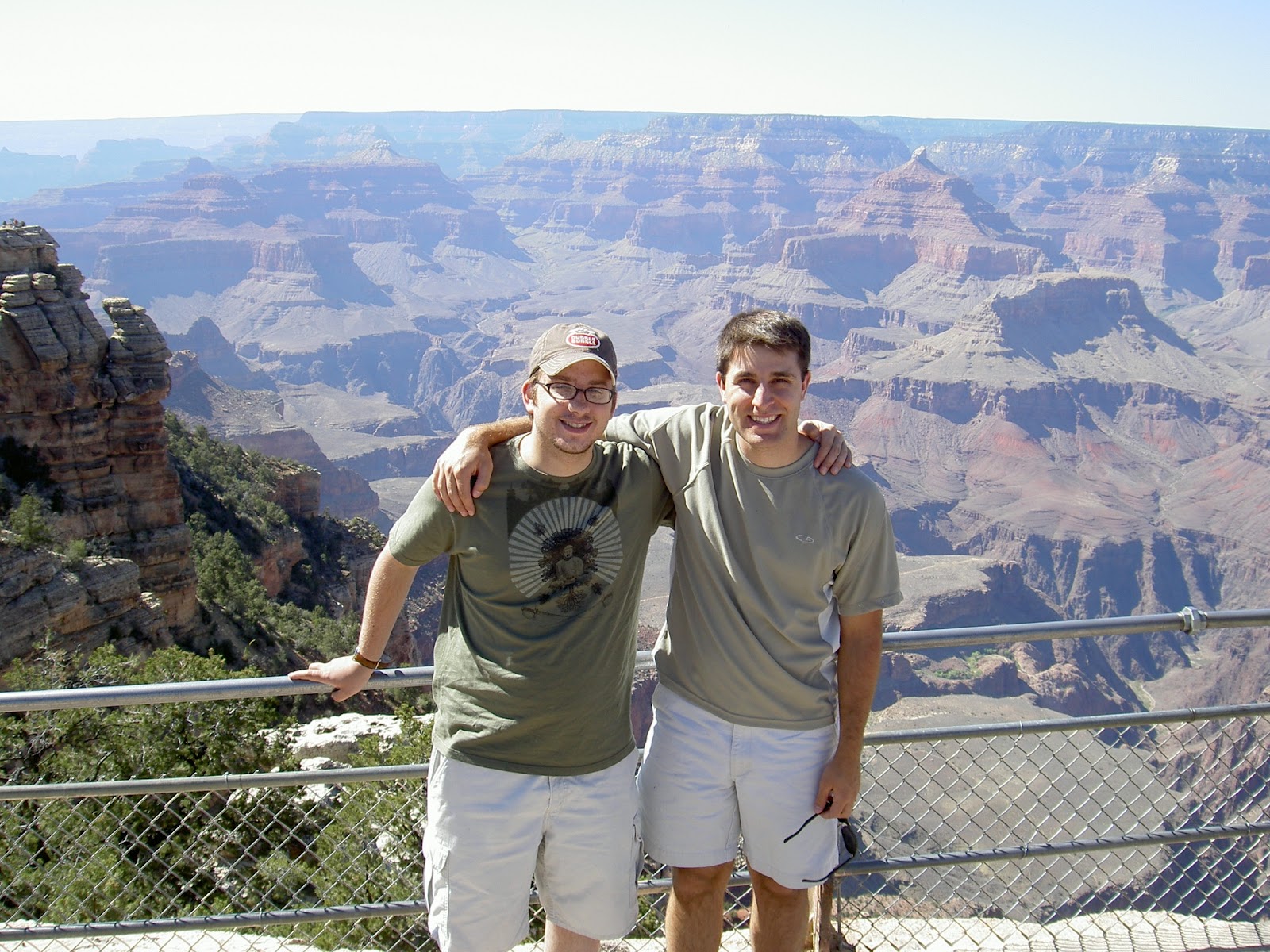 |
| Matt and I at the Grand Canyon, 2007 |
Matthew Bednarz is one of those extremely rare people who actually has loads of wisdom and love. He's the kind of person who can read the subtext in life. He's able to bring out its humor, joy, and worth--and he's been doing that for me ever since we were in the Cub Scouts at age five.
We rose, together, through the ranks of John F. Kennedy Elementary School and what I remember most about Matt is his incredible ability to make others laugh. But Matt was unique in that he didn't make people laugh at other people--instead, Matt just made people laugh. Anybody. Everybody. Matt could find the humor in any situation, whether it was discussing the small cartons of chocolate milk or the onset of puberty and the realization of girls. Matt's quick wit was evident to all of us, and my stomach often ached with joy whenever I was with him for more than five minutes (which was often).
But Matt's humor was only the beginning. because his ability to make people laugh was grounded in something even more rare: his wisdom about people and the world around him. Matt was able to see the good in everybody--and I mean everybody. he would talk with anyone, share with anyone, listen to anyone.
And Matt could write (can write). His stories, in elementary school, always evidenced something that made the rest of us say,. "Isn't Matt our age? How can he write like that?" And we'd listen to him read something he wrote or talk about a story or movie idea of his, and we'd elbow one another and think, Damn, that's really, really, really awesome the way that only fifth-graders can.
We both had Mr. Robert Looney as our teacher in fifth grade--a man who deserves a medal and his own tribute for the inspiration and joy he shared with us--and that year Matt and I were encouraged to write wildly creative and free stories. So, we did so. What we'd once penned as "Voyagers" in the second and third grades became even zanier and more twisted now. And all the while, Matt was visualizing how to film things, how to bring stories to life in a way that no one else I knew even talked about.
On weekends, Matt would hoist the large VHS camcorder onto his shoulder, pass out scripts to his other Cub Scout friends (now we'd moved on from the scouts but still got together regularly), and he'd guide us in his own self-written, self-produced, self-directed, self-edited movies. (They were, of course, always awesome). Whether it was a movie about Mars Bar and Almond Joy--anthropomorphized into mafia-esque men at battle for power--or the nuances of young love, Matt's movies always had one central message: life can be hard, crazy, unexpected, painful, weird, confusing--but it's always, always worth living 9and living to the fullest).
As we entered high school,. the characters in Matt's movies and stories grew more complex--and the stakes within the scripts were raised--but that central message remained: that life, for all its horror and pain, is still worth it. Life is still amazing, even if it's nearly impossible to see it that way sometimes. The characters in Matt's stories and movies--like Matt himself--always chose to fight on, to embody courage towards whatever they faced.
And in this regard, they always succeeded, because they always kept on going.
When Jennifer and I moved to Flagstaff in 2006, after I'd left high school teaching to go back to school for a couple of years, Matt flew out to visit and spend five days with us. We saw a lot, talked a lot, did a lot. But what I remember most about that trip was a single moment: we were outside Jen and I's little campus apartment, and the unequaled Ponderosa Pines surrounded us. I looked up at Matt, and it was like I could still still the five-year old friend with whom I played kick ball, whose jokes I laughed at till my stomach revolted against me, whose generosity of spirit, warmth, and creativity had grabbed hold of me and inspired me even then. And I looked at Matt, and it was like the 21 years that had passed from our Cub Scout days until then hadn't changed a thing.
Not at all.
Instead, we were both five-year olds, still, albeit with harrier faces, a few more battle scars. But we still saw that thing inside one another that only a friend who's known you since you were five even can see: your character arc. Your journey. Every protagonist needs to face incredible odds in order for his story to become beautiful.
In this manner, Matthew Bednarz becomes even more than an incredible protagonist. because his story isn't only about him and the odds he's had to face. Instead, it's about me, too, and every other person on whom he's had a remarkable impact through his laughter, his wisdom, his creativity, and his love.
Today, I say happy birthday to my best friend and a guy whose character arc is, to me, amazing. I'm grateful that you've let me be a part of it for so long. And I look forward to the stories still to be told, the movies still to be made, the laughter still to be had. I love you, friend.

Wednesday, April 18, 2012
Finding a Way Forward
About a month ago, the Treasurer of the Fulford Bowls club passed on--a man named Brian who was 89 years old, had proposed twice but both times was returned a negative and never married, and whose gentle smile led to easy sharing, kind encouragement. Each Thursday evening, as I talked with Brian, it was easy to see a certain longing in him: a great love of children, yet never having his own; a great love of community, yet never creating one inside his home.
The Fulford Indoor Bowls Club, then, was his route to connection. He began the club in 1984, and had served as Treasurer ever since. When I first met Brian, his words, "Welcome, now your first two sessions are free, so make sure you don't pay" were indeed music to my ears. And over the past year and a half, as I've had the chance to get to know so many men and women of an older generation, something about Brian has always captivated me.
He didn't storm the beaches of Normandy like others in the Bowls crew.
He didn't almost lose a daughter at age two.
He didn't travel to five continents and possess stories galore to make those journeys reverberate as if they were still occurring today.
Instead, Brian's story was quiet, as was his voice and even his stroll. The subtext of his words spoke to me about a man who had tried hard in this life--sought love and ended up creating a community every way he knew how. Even though it wasn't his ideal, it worked, and it brought a lot of connection and joy to others as well.
As I now try to balance the books for the Bowls club--an English major and poetry-loving teacher--I find that the numbers don't always add up for me the way they did, I'm sure, for Brian. As I hold the ledger in my hands and read through his script, each number checked with tiny dash marks in pencil, I feel a certain quietness that saunters into the room and glances over the books with me.
For Brian, even though his highest hopes never materialized, life was still beautiful because the quality of his connections ensured it. The people he treated with dignity, the stories he listened to and shared, and the quiet manner of his willingness to put his hopes into any avenue for community that he could--these all speak to the way a river finds a course. Though it runs into rocks, though it may be blocked at many turns, if it keeps seeking, then somehow it finds a way to move forward and still bring water. Like life.
The Fulford Indoor Bowls Club, then, was his route to connection. He began the club in 1984, and had served as Treasurer ever since. When I first met Brian, his words, "Welcome, now your first two sessions are free, so make sure you don't pay" were indeed music to my ears. And over the past year and a half, as I've had the chance to get to know so many men and women of an older generation, something about Brian has always captivated me.
He didn't storm the beaches of Normandy like others in the Bowls crew.
He didn't almost lose a daughter at age two.
He didn't travel to five continents and possess stories galore to make those journeys reverberate as if they were still occurring today.
Instead, Brian's story was quiet, as was his voice and even his stroll. The subtext of his words spoke to me about a man who had tried hard in this life--sought love and ended up creating a community every way he knew how. Even though it wasn't his ideal, it worked, and it brought a lot of connection and joy to others as well.
As I now try to balance the books for the Bowls club--an English major and poetry-loving teacher--I find that the numbers don't always add up for me the way they did, I'm sure, for Brian. As I hold the ledger in my hands and read through his script, each number checked with tiny dash marks in pencil, I feel a certain quietness that saunters into the room and glances over the books with me.
For Brian, even though his highest hopes never materialized, life was still beautiful because the quality of his connections ensured it. The people he treated with dignity, the stories he listened to and shared, and the quiet manner of his willingness to put his hopes into any avenue for community that he could--these all speak to the way a river finds a course. Though it runs into rocks, though it may be blocked at many turns, if it keeps seeking, then somehow it finds a way to move forward and still bring water. Like life.
Monday, April 16, 2012
We, Teachers
We stand at a place where justice meets grace.
In the thousand-thousand words we share and hear,
Constant mystery lingers from ear to ear.
Is it wrong, what I said?
The mark I gave, the essay I saved, the student whose song
I let reign today?
The questions we ask lean in towards answers,
And the answers we hear
Are echoes of the souls within the stories.
They are you.
They are me.
They laugh at the off-beat themes,
Cry at the agony, grow wide-eyed at the dreams.
At our best, we are momentum itself--
Staggering forward without a water-break, destroying the fake.
At our worst, we clutch faith like a flame,
Burning ourselves again, and again, and again.
Somewhere in between lies both the promise and the present.
We, teachers, merge the two.
We make something whole even as its blinding holes
Blink back at us.
We, teachers, every day shut our eyes against what was and
Make something new.
Subscribe to:
Posts (Atom)